
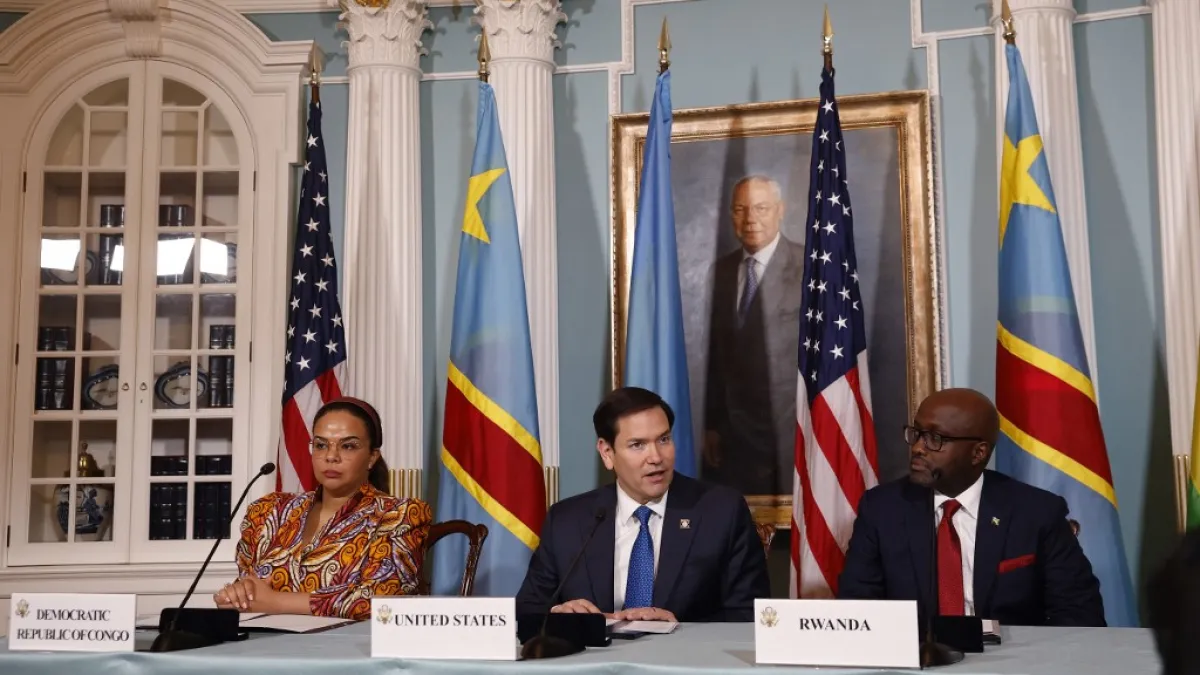
The Democratic Republic of the Congo and Rwanda have agreed to take “concrete steps” aimed at easing tensions and advancing the implementation of a fragile peace accord, following high-level talks held in Washington, D.C..
According to a joint statement released after meetings on March 17–18, 2026, representatives from both countries committed to renewed efforts to stabilize eastern Congo, a region that has remained volatile despite a peace deal signed last year under the facilitation of Donald Trump.
Renewed Diplomatic Push
The latest agreement outlines a series of coordinated measures designed to de-escalate hostilities and restore trust between the two neighbours. These include mutual commitments to respect sovereignty and territorial integrity, as well as steps toward disengagement of forces in specific areas of eastern DRC.
Rwanda is expected to lift certain defensive measures and withdraw forces from designated مناطق within Congolese territory, while the DRC has pledged to intensify operations against armed groups, particularly the Democratic Forces for the Liberation of Rwanda (FDLR).
Both sides also reaffirmed the need to prioritise civilian protection amid ongoing insecurity in the conflict-affected region.
Persistent Conflict in Eastern DRC
The mineral-rich eastern DRC continues to experience instability, largely driven by the activities of the March 23 Movement (M23), an armed group that controls key urban centres.
The United States has accused Rwanda of backing the M23 and maintaining a military presence in the region. Earlier this month, US Treasury Secretary Scott Bessent stated that thousands of Rwandan troops were actively engaged in combat operations inside Congolese territory, facilitating the group’s territorial control.
Rwanda has consistently denied supporting the M23, instead accusing the DRC government of breaching the peace deal through military offensives and drone strikes. Kigali has also called on Kinshasa to take stronger action against the FDLR, a Hutu militia group with historical links to the Rwandan Genocide.
US Pressure and Sanctions
The renewed diplomatic engagement comes amid increased pressure from Washington. The United States recently imposed sanctions on Rwanda’s military and introduced visa restrictions targeting senior officials over their alleged role in the conflict.
Rwanda has criticised the measures as biased, arguing that they unfairly single out one party while overlooking actions by the Congolese government.
Outlook
While the agreement signals a willingness from both sides to de-escalate, analysts caution that implementation will be critical. Previous accords have failed to bring lasting peace to eastern DRC, where armed groups, resource competition, and regional rivalries continue to fuel instability.
The success of the latest commitments will likely depend on sustained diplomatic oversight and verifiable actions on the ground in the coming weeks.

