
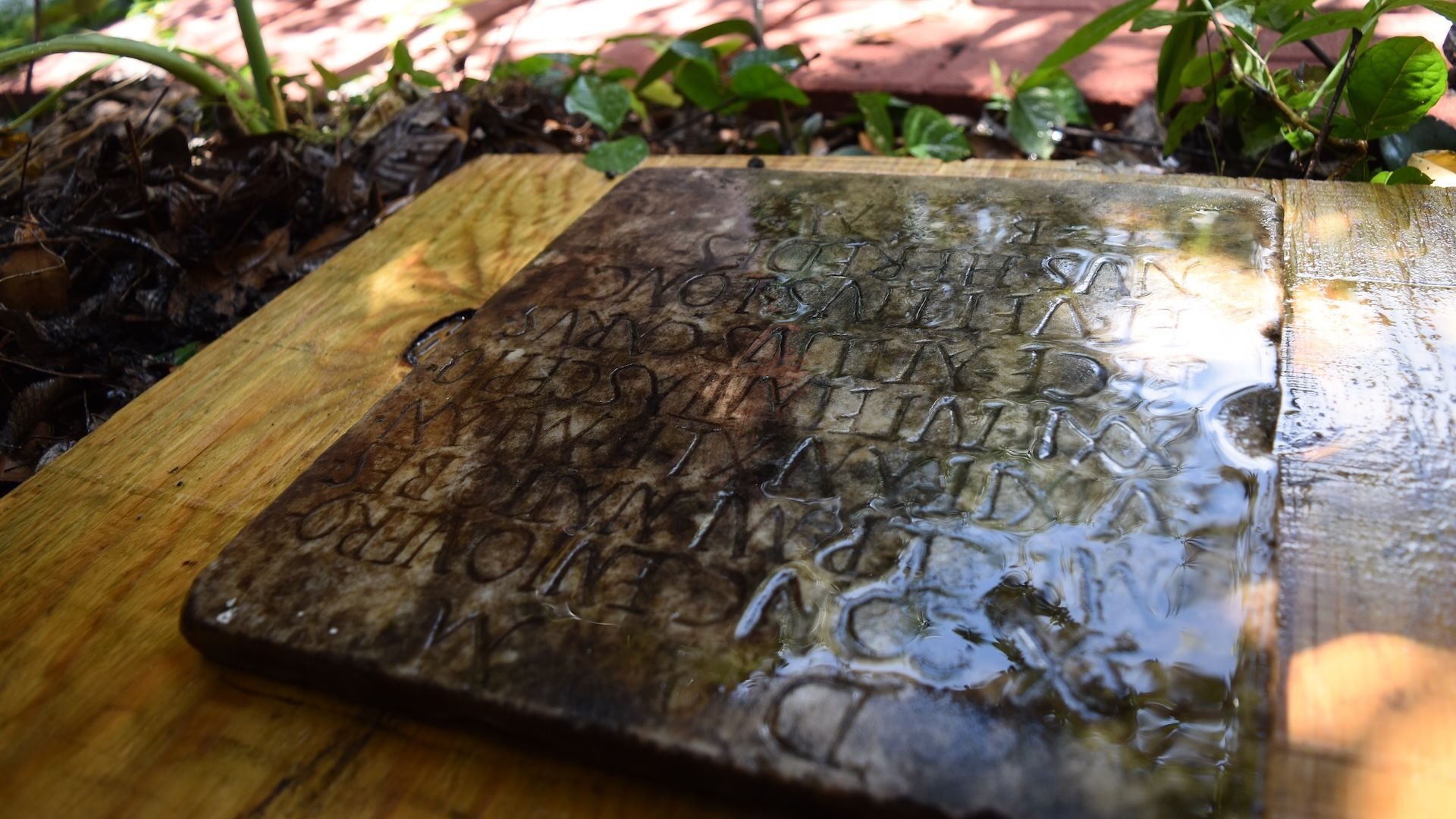
A New Orleans family’s attempt to tidy up their overgrown backyard turned into a remarkable archaeological discovery — a marble tablet inscribed in Latin and bearing the phrase “spirits of the dead.”
Tulane University anthropologist Daniella Santoro stumbled upon the relic and, suspecting its significance, contacted classical archaeologist Susann Lusnia. Lusnia identified the slab as a 1,900-year-old Roman gravestone belonging to Sextus Congenius Verus, a sailor who served over two decades in the imperial navy aboard a ship named after the god of medicine, Asclepius.
Research revealed the tablet had once been part of a 19th-century cemetery in Civitavecchia, Italy, a coastal town near Rome. The gravestone’s text had been documented in 1910 but later vanished — last recorded at the National Archaeological Museum in Civitavecchia before its destruction during World War II. The artifact’s size and inscription matched the missing record perfectly.
Lusnia confirmed that the FBI and Italian authorities are now working to repatriate the artifact.
Adding to the intrigue, former homeowner Erin Scott O’Brien recognized the tablet from media coverage. She recalled using it as a garden decoration, unaware of its origin. O’Brien’s grandparents — one Italian and one an American serviceman stationed in Italy during World War II — had passed it down, likely bringing it to the U.S. decades ago.
Experts believe Sextus Congenius Verus, who died at 42, would be pleased by the rediscovery. “In Roman culture, remembrance was everything,” Lusnia reflected. “Now, nearly two millennia later, Sextus is being remembered once again — exactly as he would have wished.”

