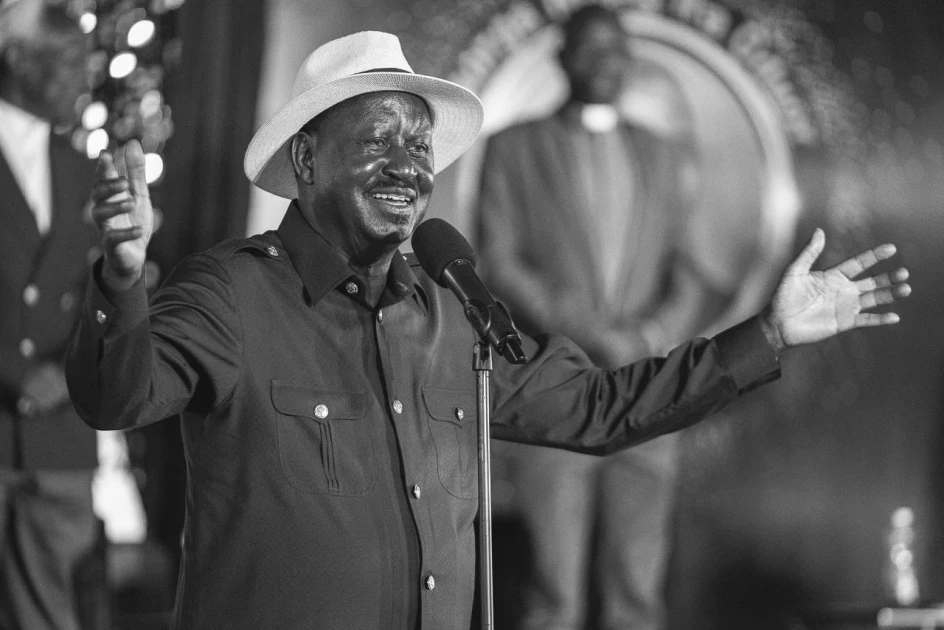
Kenya is in deep mourning following the death of Raila Amolo Odinga, the country’s former Prime Minister and long-serving opposition leader, who passed away on Wednesday, October 15, 2025, in Kerala, India, at the age of 80.
Odinga’s passing has plunged the nation into grief and uncertainty, as Kenyans reflect on the immense political and social impact of a man who shaped the country’s democratic journey for decades.
Final Days of the Statesman
The veteran leader, affectionately known as “Baba”, had been recuperating in India before his death. His last public appearance was on September 22, when he chaired an ODM Parliamentary Group meeting in Nairobi to discuss the party’s upcoming 20th anniversary celebrations and its legislative agenda.
He later made a brief appearance on October 3, where he was updated on the anniversary plans before celebrating his sister Akinyi Walkowa Odinga’s academic milestone — earning a PhD in Management Sciences from Durban University of Technology in South Africa. That same day, Odinga also met Gor Mahia FC’s executive team to discuss the club’s preparations for the new football season.
Following these engagements, the political icon retreated from public life, sparking widespread speculation about his health and whereabouts.
Rumours, Clarifications, and Family Reassurances
As Odinga remained inactive on social media, speculation intensified. On October 5, the Orange Democratic Movement (ODM) dismissed rumours of his ill health, clarifying that he had travelled abroad on a private mission.
Two days later, Mama Ida Odinga reassured the public that her husband was in good health, dismissing the rumours as politically motivated. “Raila Odinga is fine. Someone who doesn’t live with him cannot claim to know his health better than I do,” she said during an event in Nyanza.
To further ease public concern, Siaya Senator Oburu Oginga, Raila’s elder brother, confirmed that the former Prime Minister was indeed in India recovering and not in critical condition, as alleged by some quarters. “He is well and will be back soon,” Oburu said on October 11.
Deputy President Kithure Kindiki also weighed in, condemning those spreading falsehoods. “Mzee Raila Odinga is safe and healthy. It is un-African to wish ill upon anyone, even a political opponent,” Kindiki stated in Siaya on October 13.
The Tragic Final Moments
According to Indian authorities, Raila collapsed while walking with his sister, daughter, and personal doctor near the Sreedhareeyam Ayurvedic Eye Hospital and Research Centre in Koothattukulam, Kerala, where he had been receiving treatment.
“He experienced breathing difficulties and collapsed. CPR was administered immediately, and he was rushed to a nearby hospital, but despite all efforts, doctors were unable to save him,” said a hospital spokesperson.
Indian police confirmed that both Kenyan and Indian security officers were present at the time of the incident.
A Life of Struggle, Resilience, and Service
Raila Odinga’s political journey spanned over four decades, marked by imprisonment, exile, and a relentless fight for democracy during President Daniel arap Moi’s regime.
He first entered Parliament in 1992 and ran for the presidency five times — in 1997, 2007, 2013, 2017, and 2022 — maintaining that he was unfairly denied victory in the latter four contests.
Beyond politics, Odinga was admired for his charisma, resilience, and unwavering commitment to national unity and reform. At the time of his death, he was serving as a co-leader in a broad-based government initiative alongside President William Ruto, aimed at strengthening governance and service delivery in Kenya.
As Kenya comes to terms with the loss of one of its most consequential leaders, tributes continue to pour in from across the nation and the world a testament to the enduring legacy of a man who defined generations of political struggle and hope.