South Africa is preparing for an expanded domestic military deployment as President Cyril Ramaphosa moves to confront spiraling violent crime, entrenched gang activity, and the growing threat of illegal mining networks.
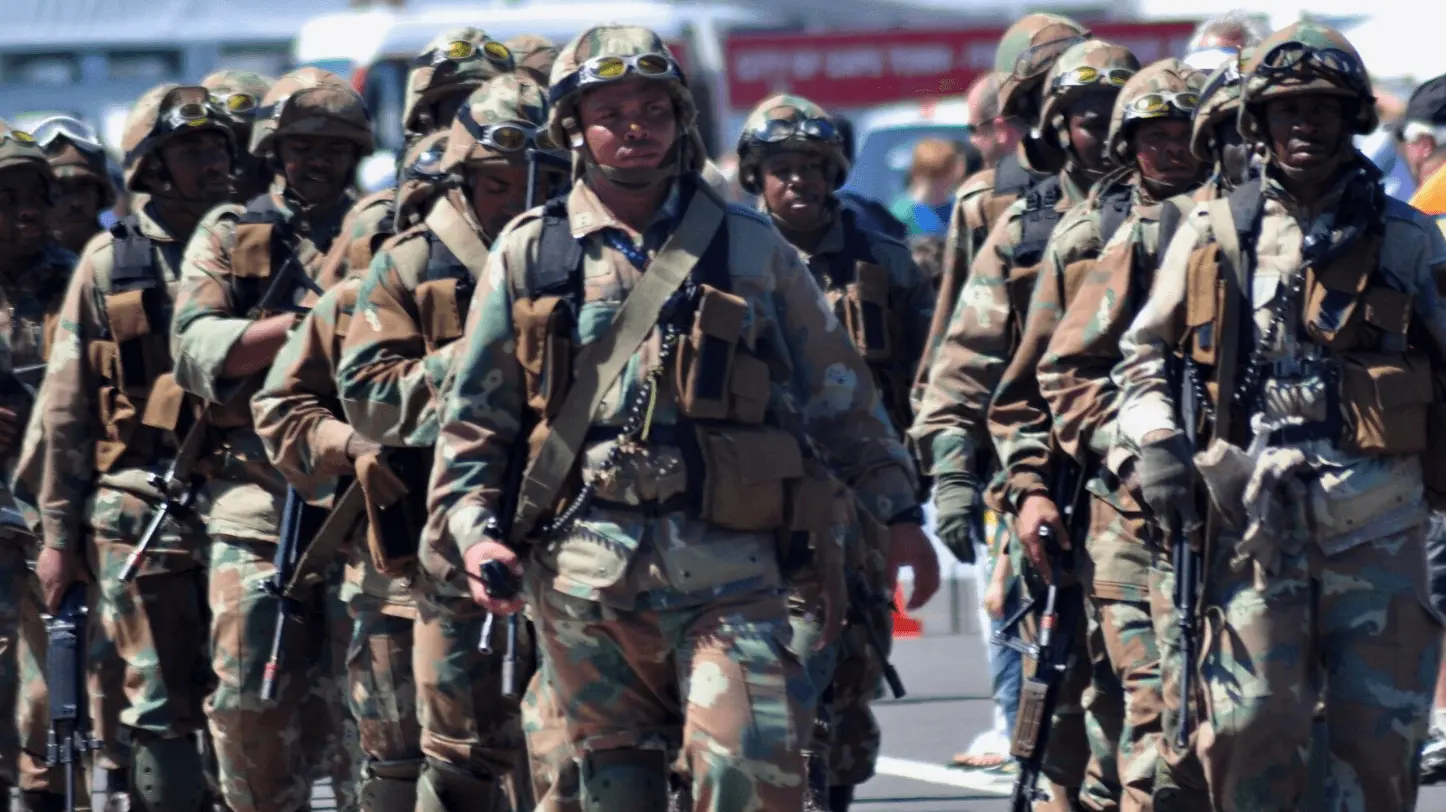
Earlier this month, President Ramaphosa announced that the South African National Defence Force (SANDF) would be deployed to high-crime areas in three of the country’s nine provinces. The move, he said, is aimed at countering what he described as the “most immediate threat” to South Africa’s democracy and economic development: organized crime and lawlessness.
While no specific timeline was provided, the announcement underscores the gravity of South Africa’s security challenges particularly in urban and peri-urban areas where policing alone has struggled to contain violence.
Gang Violence in Cape Town’s Periphery
One of the focal points of the deployment will be the Western Cape, home to Cape Town, South Africa’s second-largest city and a major international tourist destination. Beyond its scenic coastline and vibrant city center, the city’s outskirts collectively known as the Cape Flats remain plagued by persistent gang warfare.
For decades, rival gangs such as the Americans, the Hard Livings, and the Terrible Josters have battled for control of the illicit drug trade. Their operations extend beyond narcotics into extortion, prostitution, and contract killings. Civilians, including children, are frequently caught in the crossfire.
According to the latest crime statistics, the three police precincts with the highest rates of serious crime nationwide are all located in and around Cape Town. Authorities estimate that roughly 90 percent of South Africa’s gang-related killings occur in the Western Cape province.
Community activists say residents are desperate for relief. Craven Engel, founder of the violence-interruption group Ceasefire, said communities such as Hanover Park hope the military presence will at least provide temporary calm. “Even one day without shooting is something people celebrate,” he noted.
Illegal Mining and Syndicated Crime in Gauteng
The army is also expected to deploy to Gauteng, the economic heart of the country and home to Johannesburg. Here, authorities face a different but equally dangerous threat: illegal mining.
Across Gauteng and surrounding areas, thousands of abandoned mine shafts have become hubs for illicit gold extraction. The miners commonly referred to as zama zamas are often controlled by heavily armed criminal syndicates that operate with extreme violence to protect their turf.
Analysts say these syndicates recruit informal miners from impoverished communities, sending them underground to search for remaining mineral deposits. The networks are frequently linked to violent crime in nearby neighborhoods, including forced displacement of residents due to turf wars.
Illegal mining has also been associated with high-profile atrocities. In 2022, the country was shocked by allegations that around 80 illegal miners gang-raped eight women at an abandoned mine. More recently, a standoff between police and miners resulted in at least 87 deaths after authorities cut off food supplies in an attempt to force miners to surface.
The government estimates that more than 30,000 illegal miners operate across some 6,000 abandoned shafts nationwide, with gold losses exceeding $4 billion annually. The trade is believed to be dominated by migrants from neighboring countries, including Lesotho, Zimbabwe, and Mozambique fueling xenophobic tensions in affected communities.
A Contested Strategy
President Ramaphosa has framed the military deployment as a necessary escalation in the face of sophisticated criminal networks. However, critics argue that sending soldiers into civilian areas risks normalizing militarization and may be interpreted as an admission that conventional law enforcement has failed.
The Eastern Cape province is also expected to see troop deployments, reflecting the nationwide scope of the challenge. Whether the army’s presence will bring lasting stability or merely short-term relief remains an open question.
What is clear is that South Africa’s battle against organized crime has entered a new and consequential phase, one that will test the balance between security, civil liberties, and the long-term resilience of the state.