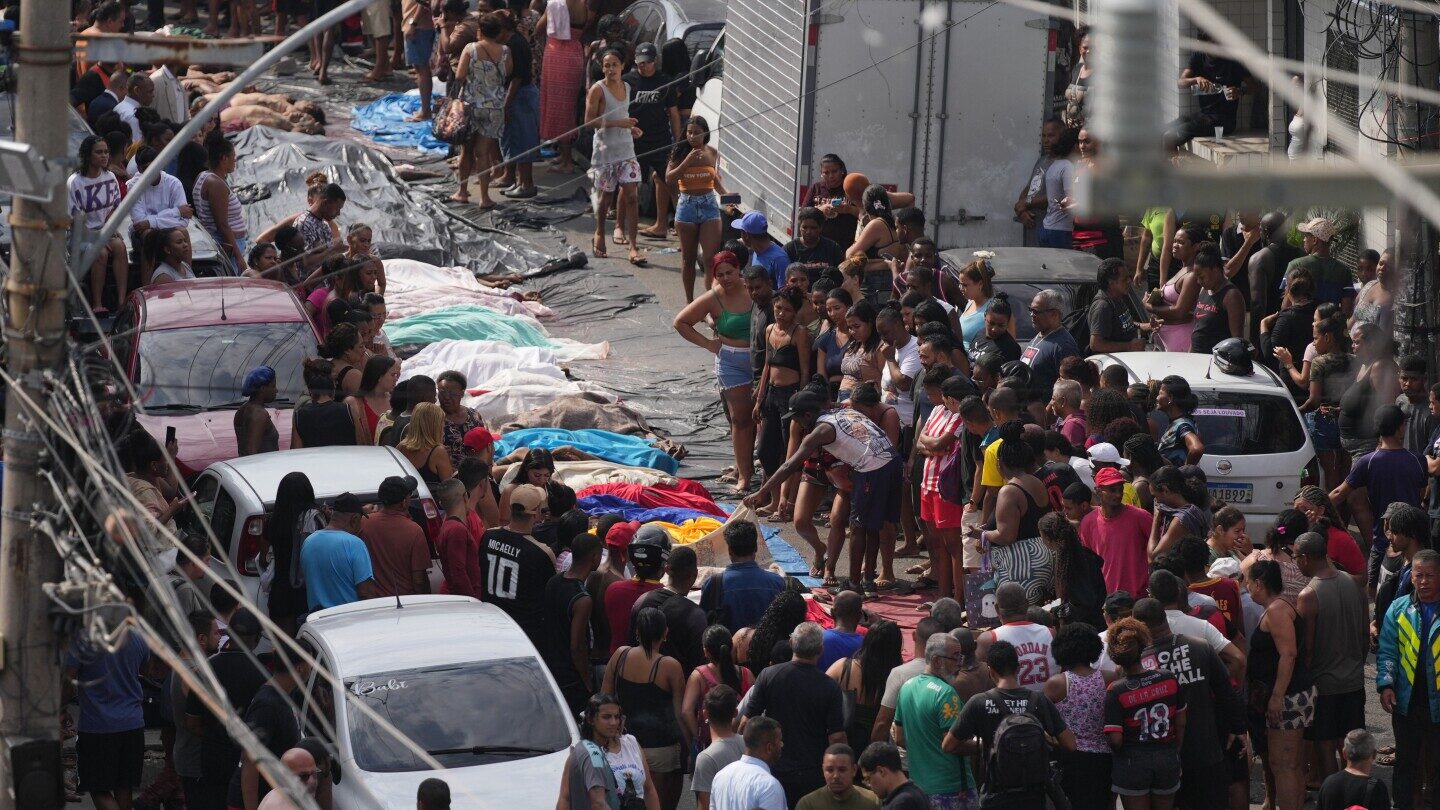
Harrowing scenes unfolded in Rio de Janeiro on Wednesday as residents laid out bodies in the streets following Brazil’s deadliest police raid in history, which left at least 119 people dead. The operation, targeting drug gangs in the city’s favelas, has reignited fierce debate over Brazil’s heavy-handed approach to organized crime.
President Luiz Inácio Lula da Silva urged authorities to confront criminal networks “without endangering civilians or police officers,” as global attention turns to Brazil just days before it hosts the COP30 UN climate summit in the Amazon.
Families of victims accused police of carrying out summary executions, while state officials defended the raid as a major blow against the powerful Comando Vermelho (Red Command) gang.
According to state authorities, 115 of the dead were alleged gang members, while four were police officers.
“We cannot accept that organized crime continues to destroy families and spread violence across our cities,” Lula said on X. “We must strike at the heart of drug trafficking without risking innocent lives.”
Justice Minister Ricardo Lewandowski traveled to Rio to meet with Governor Claudio Castro, pledging federal support to help stabilize the situation.
Residents Describe Brutal Killings
In the aftermath, residents of Complexo da Penha one of Rio’s largest favelas recovered dozens of bodies from nearby forests. Witnesses described disturbing scenes, including mutilations.
“They slit my son’s throat and hung his head from a tree like a trophy,” said Raquel Tomas, whose 19-year-old son was among the victims. “He was executed without a chance to defend himself.”
Lawyer Albino Pereira Neto, representing several bereaved families, said many bodies showed signs of torture and burn marks. “Some were murdered in cold blood,” he told AFP.
International Reaction and Legal Scrutiny
The UN expressed deep alarm over the bloodshed. Secretary-General António Guterres said he was “greatly concerned” by the loss of life, while the UN Human Rights Office called for “swift and impartial investigations.”
Supreme Court Justice Alexandre de Moraes has summoned Governor Castro to explain the police actions amid growing domestic and international pressure.
‘Battle in the Forest’
The raid, which involved helicopters, armored vehicles, and drones, targeted the Red Command’s operations in two sprawling favelas. Authorities said gang members retaliated by hijacking buses, blocking highways, and deploying drones equipped with explosives.
Governor Castro defended the operation as a success in the fight against what he called “narcoterrorism,” insisting that “only police officers were victims.”
Police officials said the mission had been planned for over a year. Military Police Secretary Marcelo de Menezes claimed that elite units deliberately pushed suspects into a nearby forest to “protect the local population.”
Authorities reported the arrest of 113 people, the seizure of 91 rifles, and a large quantity of drugs.
However, as families mourn and human rights organizations demand answers, the raid has once again laid bare the deep divide between Brazil’s security forces and the residents of its marginalized communities.