Authorities in Cape Town are facing growing criticism over plans to construct a safety wall along a major highway connecting the city centre to the airport, a project intended to curb violent crime but which critics say exposes deeper social divisions in South Africa.
The project, part of the N2 Edge safety initiative, will involve building a nearly nine-kilometre barrier along a section of the busy N2 highway that passes through areas lined with informal settlements and townships. City officials say the structure will act as a protective barrier against attacks that have plagued the route for years.
Persistent Crime Along Key Transport Route
The N2 highway is one of the most heavily used routes in the city, serving thousands of commuters and tourists traveling between Cape Town International Airport and the central business district. However, the corridor has long been associated with incidents such as car hijackings, robberies, and smash-and-grab attacks during slow-moving traffic.
E-hailing driver Mustafa Hashim described how attackers often target vehicles stuck in traffic. According to drivers familiar with the route, criminals sometimes break car windows with stones and steal valuables within seconds.
City authorities announced the nearly $7 million project in December after a woman was fatally stabbed near a traffic light just off the highway.
What the Project Involves
A central component of the plan is a three-metre-high safety barrier designed to reinforce an existing damaged fence along the road. Officials say the barrier will prevent criminals, pedestrians, and animals from accessing the highway.
Geordin Hill-Lewis, the city’s mayor, said public safety concerns from commuters were a key factor behind the initiative.
He noted that “hundreds of thousands of people use that road every day,” many of whom report feeling unsafe while traveling along the corridor.
Critics Say the Wall Addresses Symptoms, Not Causes
Despite the city’s justification, the proposal has triggered strong opposition from civil society groups and local residents. Critics argue the barrier risks symbolically and physically separating poorer communities from wealthier parts of the city.
Some activists believe the wall is an attempt to shield tourists from the visible realities of poverty as they enter the city.
The planned structure will run alongside the township area of Nyanga, one of the most crime-affected communities in the country.
Residents of the settlement say they are themselves victims of the same crimes affecting motorists and question whether the wall will improve safety within their community.
Crime Statistics Highlight Deeper Challenges
Police statistics illustrate the scale of the problem. Between October and December 2025, the Nyanga Police Station recorded the highest number of robberies with aggravating circumstances in South Africa.
The area also ranked second nationally for murder cases, with incidents increasing by 29 percent compared with the previous quarter.
Community leaders argue that addressing crime requires investment in social infrastructure rather than physical barriers.
Calls for Community Development
Local activists and community representatives are urging the city government to focus on improving living conditions in informal settlements.
Suggestions include installing 24-hour surveillance systems, improving sanitation infrastructure, and addressing safety risks faced by women who must use outdoor toilets at night.
Criticism of the project has extended beyond community forums. During the recent Cape Town Pride celebrations, activists carried banners reading “Homes Not Walls,” highlighting broader frustrations over inequality and urban segregation.
A City of Contrasts
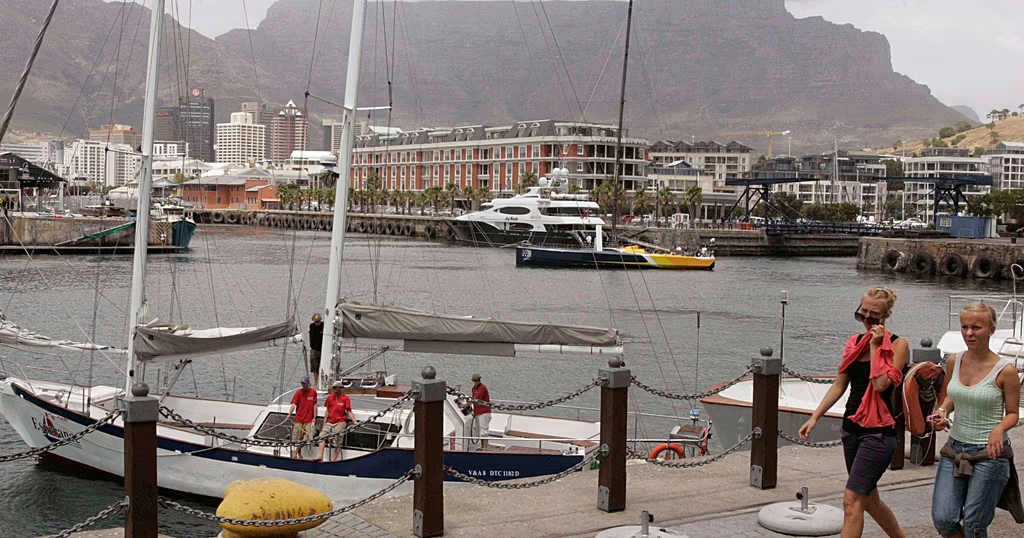
Cape Town is globally known for its scenic coastline, mountains, and tourism sector, attracting millions of visitors each year. However, crime remains heavily concentrated in poorer neighbourhoods located far from the city’s affluent suburbs and popular attractions.
The debate over the N2 wall reflects longstanding tensions about how best to tackle urban crime without deepening spatial divisions that date back to the apartheid era.
In response to escalating gang violence in certain areas, Cyril Ramaphosa recently announced the deployment of military forces to parts of the city experiencing intense gang conflicts.
As discussions continue, the proposed barrier has become more than a security project it now represents a broader debate about safety, inequality, and the future of urban development in Cape Town.