Leaders of the East African Community (EAC) have adopted a series of reforms aimed at promoting equity, fairness, and stronger cooperation within the regional bloc.
The decisions were reached during the 25th Ordinary Summit of EAC Heads of State held in Arusha, Tanzania, on Saturday, where regional leaders deliberated on institutional reforms, financial contributions, and strategies to deepen integration among member states.
New Contribution Formula Based on Economic Strength
Outgoing Chairperson of the EAC Heads of State Summit, William Ruto, announced that the bloc had agreed to revise its financial contribution framework to better reflect the economic strength and benefits derived by individual member states.
Under the new arrangement, member states with larger economies will contribute more toward the regional body’s budget.
“This morning, we have decided that Member States with bigger economies and benefit more from the EAC should pay more,” Ruto said during his handover statement.
According to the new formula, all eight member states will collectively contribute 50 percent of the EAC’s annual budget, while the remaining portion will be assessed based on each country’s capacity to pay.
The summit also resolved to waive 50 percent of outstanding arrears owed by partner states and granted them a two-year grace period to settle the remaining balances.
Leadership Changes in the Regional Bloc
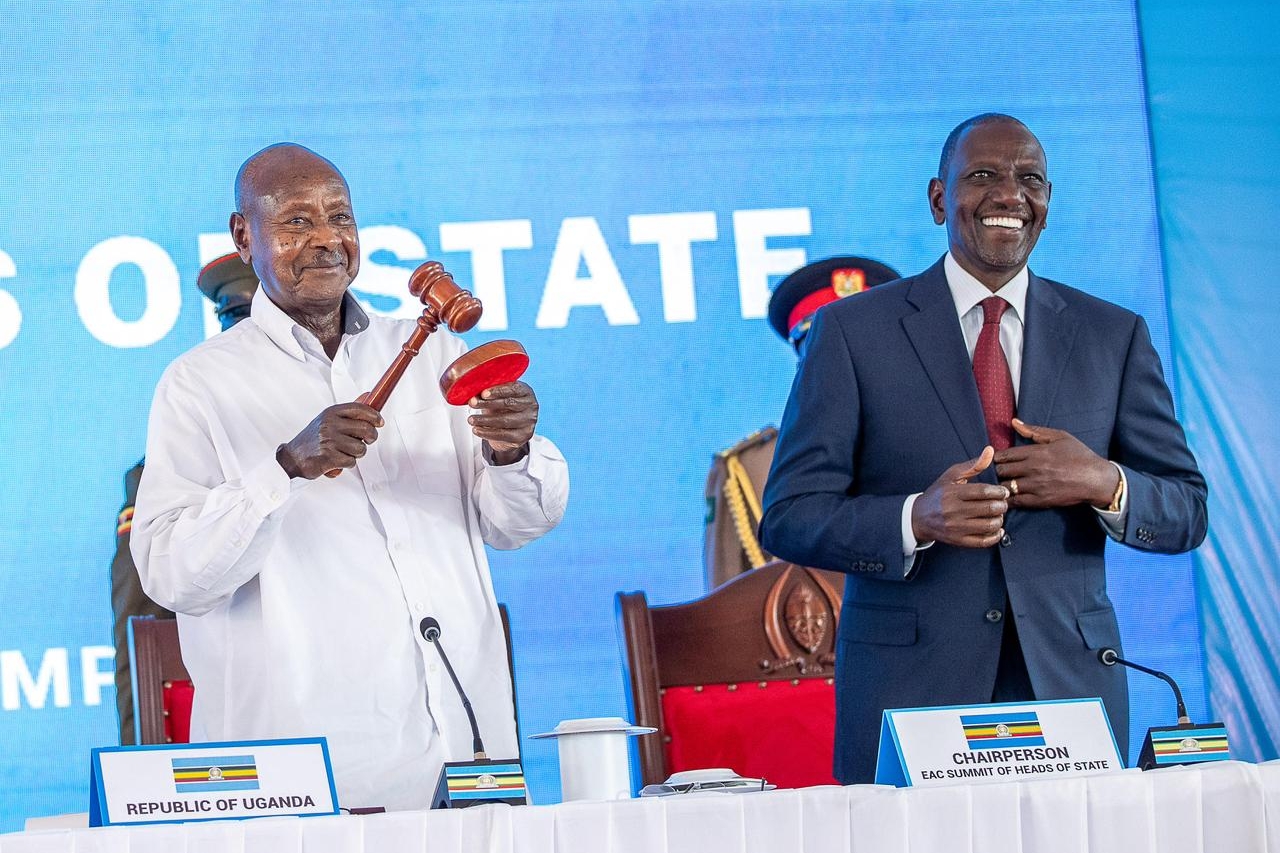
During the summit, Yoweri Museveni, President of Uganda, was elected the new Chairperson of the EAC Heads of State Summit, succeeding Ruto.
Leaders present at the meeting included Samia Suluhu Hassan of Tanzania, Évariste Ndayishimiye of Burundi, and Hassan Sheikh Mohamud of Somalia, alongside development partners and members of the diplomatic corps.
The summit also appointed Steven Patrick Mbundi of Tanzania as the new EAC Secretary-General, replacing Veronica Nduva of Kenya, who had served in the role since June 2024.
Additionally, Rwanda was elected Rapporteur of the Summit.
Judicial Appointments to the East African Court of Justice
The summit also witnessed the swearing-in of three new judges to the East African Court of Justice.
The newly appointed judges include Abdullahi Warsamme from Somalia, Anne Amadi from Kenya, and Digo Stephen Abraham from South Sudan.
Institutional Reforms and Governance Changes
EAC leaders also agreed that future nominations to the top five positions within the regional organization will depend on whether the nominating member state has ratified the East African Treaty and fully paid its financial obligations.
In addition, leaders resolved that future decisions within the bloc will require unanimous agreement or a quorum of at least 65 percent of member states present.
Another major resolution stipulates that beginning in December 2027, member states will be responsible for paying the salaries of their representatives in the East African Legislative Assembly after the end of the current term.
Regional Trade and Economic Growth
During the summit, Ruto highlighted progress made during his 15-month chairmanship, particularly in promoting regional trade and addressing security challenges such as the conflict in the Democratic Republic of the Congo.
He noted that intra-regional trade increased significantly, rising by nearly 22 percent from $33 billion in 2024 to $40.3 billion in 2025.
Exports from the region grew by 32 percent to reach $19.6 billion, while imports rose by 13 percent to $20.6 billion. This development helped reduce the region’s trade deficit from $3.4 billion to $1.0 billion.
Call for Greater Regional Market Integration
In his acceptance speech as the new chairperson, President Museveni emphasized the importance of expanding trade within the region and across the African continent.
“If we do not create a big and reliable market for our wealth creators, how do businesses expand to produce more products, create more jobs and pay more taxes?” he asked.
He also urged young people across Eastern Africa and the broader continent to embrace unity and avoid actions that could undermine regional progress.
Launch of New Development Strategy
The summit also formally launched the EAC Seventh Development Strategy for the 2026/27–2030/31 period, alongside the introduction of the East African Customs Bond aimed at strengthening regional trade facilitation.
Representatives from other member states also attended the summit, including Justin Nsengiyumva, Prime Minister of Rwanda, Monday Kumba of South Sudan, and Floribert Anzuluni Isiloketshi of the Democratic Republic of the Congo.
The reforms and initiatives agreed upon during the summit are expected to strengthen the institutional framework of the East African Community and deepen economic integration among member states.