
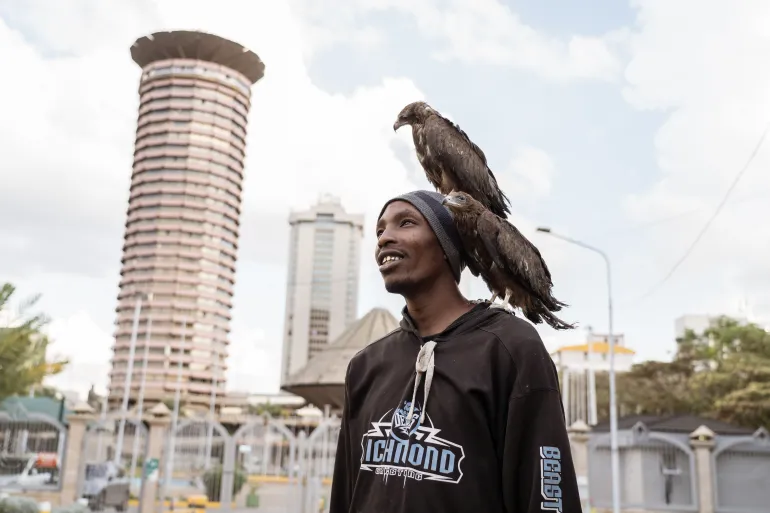
A man who once lived on the streets now shares his modest home with a small flock of rescued birds, dedicating his life to wildlife care despite enormous personal challenges. Rodgers Oloo Magutha has nursed dozens of injured kites, owls, storks, and other avian species back to health, filling a critical gap in Kenya, where few rehabilitation centers exist.
Rodgers’ love for birds began in childhood near Lake Nakuru National Park. Living just steps from the lake, he would often sneak into the park, mesmerized by the flamingos, kites, storks, and other birds. “I used to sneak inside to see the birds, to watch the water,” he recalls. “That’s when my passion for rescuing and taking care of birds started.”
Over the years, that early fascination transformed into a life mission. Rodgers has rescued over twenty different species, including black kites, African pied crows, barn owls, marabou storks, and pigeons. Some arrive with broken wings, others starving, tangled in traps, or weakened by disease. With care and patience, many eventually return to the skies. “They are thriving in nature and they are so happy,” he says. “Mine is to rescue them and then set them free to explore nature.”
Rescuing Without a Home
Rodgers’ journey has been far from easy. He spent years living on the streets, often alongside the birds he cared for. “We used to stay with the birds on the streets,” he explains. Even now, with a small home of his own, feeding and caring for species such as marabou storks remains a challenge due to their large dietary needs. Limited access to veterinary support also adds to the strain.
His dedication has sometimes led to misunderstandings, with some accusing him of sorcery because of his close bond with the birds. Yet, despite these obstacles, Rodgers continues, driven by his passion.
Filling a Critical Gap in Bird Conservation
Conservation expert Paul Gacheru of Nature Kenya emphasizes the importance of Rodgers’ work. Kenya’s birds face numerous threats, from habitat loss to collisions with power lines, poisoning, and injuries from human activity. Rehabilitation skills are essential, and legally, wildlife treatment requires licensing from the Kenya Veterinary Board. However, with few facilities available, passionate individuals like Rodgers play a vital role in protecting avian species.
Rodgers dreams of opening a formal, legal bird rescue center safe, well-equipped, and capable of housing more birds. Until that day, he continues his work quietly, guided by the same wonder he felt as a boy watching birds soar over Lake Nakuru. His story is a testament to resilience, passion, and the difference one individual can make for wildlife conservation.

