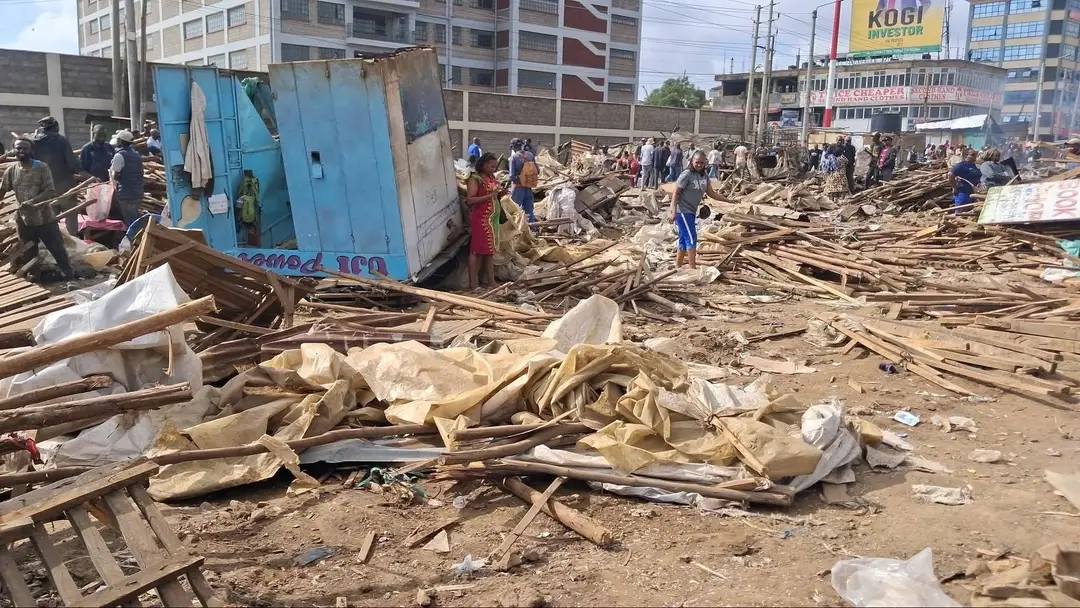
More than 1,000 traders at Githurai Market are reeling from heavy losses after their stalls were demolished early Thursday morning to pave way for the construction of a new bus park.
Demolition Operation
The clearance was carried out by the Kenya National Highways Authority (KeNHA), just a day after traders staged protests against the planned demolition. Authorities said the operation targeted sections of the busy Thika Superhighway encroached by roadside traders, including areas in Roysambu and Githurai, to allow for the construction of designated bus bays and ensure orderly passenger pick-ups and drop-offs.
Traders’ Outcry
The traders, who had received vacation notices, faulted the government for failing to provide alternative trading spaces before the demolition. Many said the stalls were their only source of livelihood and accused authorities of pushing them deeper into poverty.
They also criticized the government for breaking promises to end forced demolitions across the country, arguing that the latest clearance contradicted those assurances.
Political Reaction
Former Deputy President Rigathi Gachagua condemned the demolition, calling it inhumane.
“Treating citizens as criminals while they struggle to navigate a mutilated economy is a new low for a government led by elites who are completely disconnected from the realities faced by ordinary people,” Gachagua said.
He added that the move highlighted the government’s disconnect from the struggles of ordinary Kenyans, worsened by poor leadership and policy decisions.
Security Concerns
By Thursday afternoon, heavy police deployment was reported in the area amid fears of fresh protests along the busy highway. Traders warned that the demolition had not only crippled their businesses but also heightened tensions in the community.
Conclusion
The Githurai Market demolition underscores the growing friction between infrastructure development and the livelihoods of small-scale traders. While KeNHA insists the clearance is necessary for public order and transport efficiency, affected traders argue that the government must balance modernization with social and economic protection for vulnerable citizens.