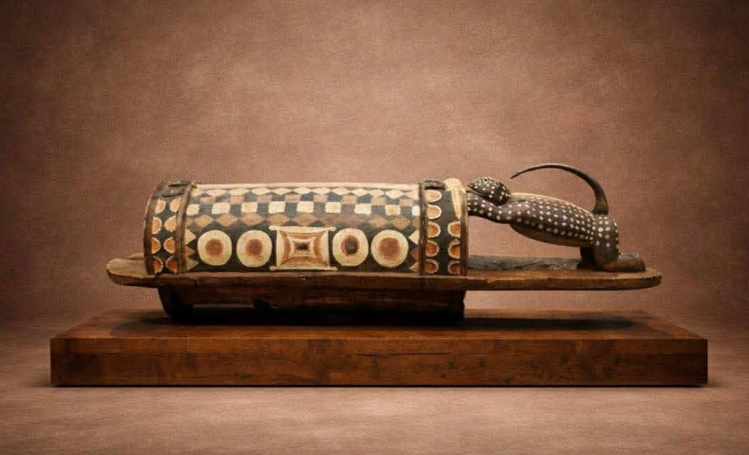
After more than a century away, a sacred drum taken by French colonial forces has been returned to the Ivory Coast, marking a historic moment in the country’s cultural restoration efforts.
The drum, known as the Djidji Ayôkwé, was initially seized by colonial authorities in 1916 and transported to France in 1929. It was displayed at the Trocadéro Museum and later the Quai Branly Museum in Paris. Members of the Ebrié community, the drum’s original custodians, received it with ceremonies acknowledging its cultural and historical significance.
Measuring over three metres (10 ft) in length, weighing around 430 kg (68 stone), and carved from iroko wood, the drum holds a central place in Ebrié heritage. Traditionally, talking drums like this were used to warn of danger, summon communities for ceremonies, and mobilise people during times of conflict.
The return is part of a broader French initiative to repatriate African cultural artefacts, a process that began in 2017. The drum arrived in Abidjan aboard a specially chartered plane but remained in its large wooden crate marked “fragile” for the ceremony. A traditional dance troupe and local chiefs were present at Abidjan International Airport to welcome it home.
“This is a historic day with a lot of emotions,” Ivory Coast’s Culture Minister Françoise Remarck told the BBC. “We are living through a moment of justice and remembrance that finally marks the return of the Djidji Ayôkwé to its land of origin.”
Francis Tagro, director of the Museum of Civilisations in Abidjan, said the drum will be displayed “in a place of honour in the heart of the national museum. We are deeply happy and proud to receive this sacred drum. It means so much to us; it will elevate the sense of culture of the young generation.”
The restitution follows a special law passed by the French parliament on 20 February, allowing the formal return of the drum. It is the first object on a list of 148 works the Ivory Coast seeks to reclaim from France and other countries. France has previously repatriated some Abomey royal treasures to Benin and a historic sabre to Senegal.
Amid growing requests from former colonies, France’s Senate adopted a framework law on 29 January 2026, designed to streamline the restitution of colonial-era artefacts. The law is expected to be debated soon by the National Assembly.
The return of the Djidji Ayôkwé symbolizes not only the physical repatriation of cultural heritage but also a step toward historical justice, reconciliation, and the preservation of African traditions for future generations.