In Gaza, where years of conflict have displaced millions, some families now find themselves living among the dead. Cemeteries across the besieged enclave have become unlikely shelters for those with nowhere else to go.
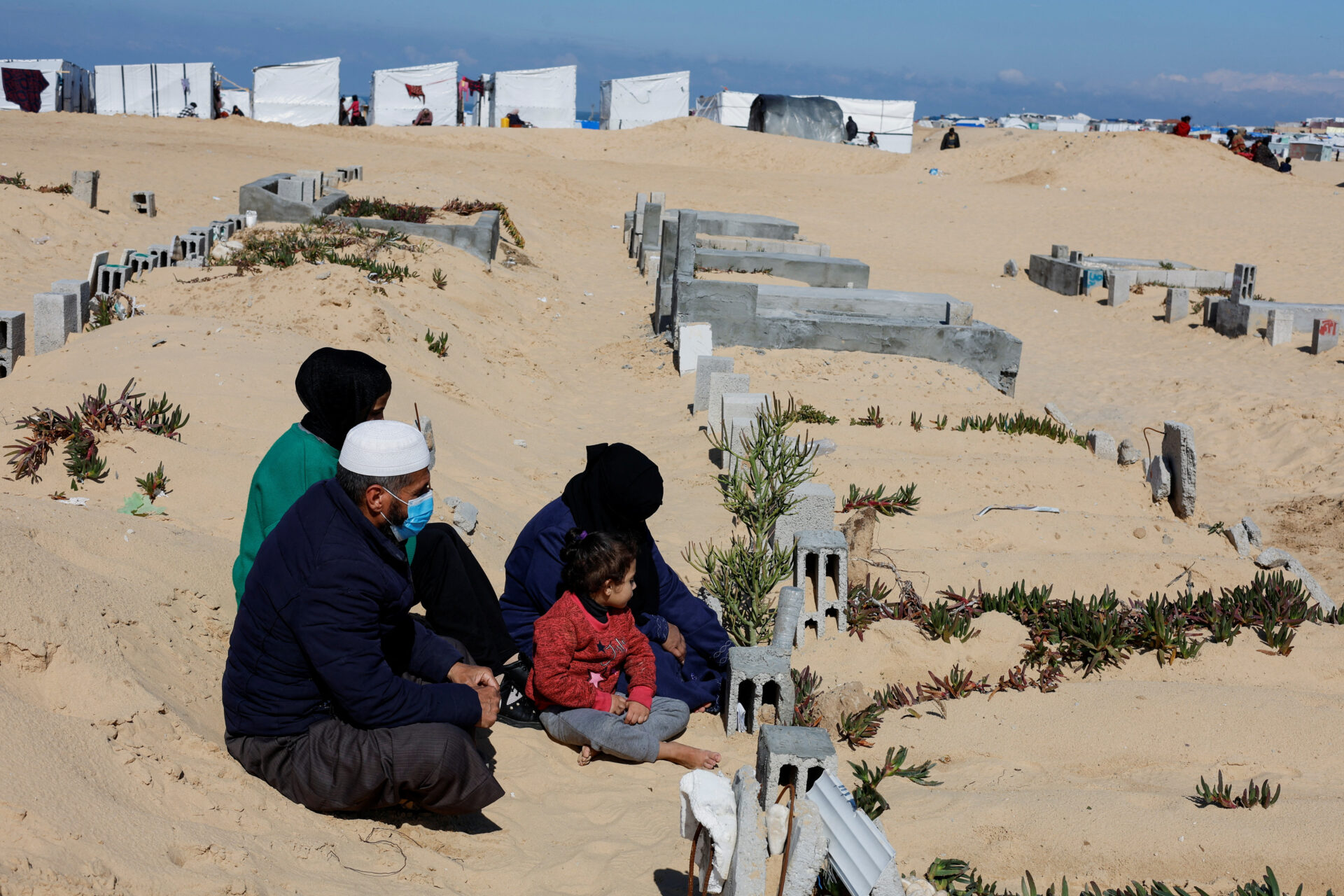
For Maisa Brikah and her children, gravestones in a dusty cemetery in Khan Younis have served as makeshift furniture for the past five months. Around 30 families share this burial ground, transforming it into a fragile refuge. Children play between tombstones and draped tents, while prayer mats and cooking fires bring traces of daily life to a place meant for eternal rest.
But when darkness falls, fear settles in.
“When the sun goes down, the children get scared. I have four small ones they’re afraid to go out because of the dogs at night, and the dead,” Brikah said.
The war between Hamas and Israel, now in its second year, has displaced nearly all of Gaza’s more than two million residents. While a ceasefire that began on October 10, 2025, has allowed some families to return to the ruins of their homes, many remain trapped in overcrowded or unsafe areas. In parts of Gaza still outside Israeli control, cemeteries have become unexpected sanctuaries.
Brikah’s former home in Khan Younis was destroyed, and with Israeli troops now occupying her neighborhood, returning is impossible. Her new “neighbors” include Ahmad Abu Said, a man who died in 1991, whose name and Quranic verses are etched into a nearby tombstone. “It doesn’t feel right to live here,” Brikah admitted, “but we have no other choice.”
Others, like Mohammed and Hanan Shmah, have also made the cemetery home. Displaced from northern Gaza, they arrived three months ago after losing their house. “I’m a grown man, but I still get scared of the graves at night,” Mohammed said. “I hide in my tent.”
The couple struggles to survive with little money and scarce water. “Life in the cemetery is full of fear, dread, and sleeplessness,” Hanan said as she carefully washed dishes with soap in a small tin container.
Even in death, there is no real safety. The United Nations and other observers have documented bombings of cemeteries during the conflict. Israel has accused Hamas of using some burial grounds as cover, arguing that this removes their protected status under international law.
The war has also disrupted traditional burial practices. With morgues and cemeteries overwhelmed, families have been forced to bury loved ones in courtyards, roadsides, or hospital grounds far from their ancestral graves.
In Gaza, where life and death have become inseparable, families like Brikah’s cling to survival even if it means living among the tombstones.