North Korea’s legislature has re-elected Kim Jong Un as President of State Affairs, reinforcing his leadership of the country’s highest governing body, according to state media reports released on Monday.
The decision was announced by the Korean Central News Agency (KCNA) following a session of the Supreme People’s Assembly (SPA) held on March 22, marking the first major state activity of the assembly’s 15th term.
Consolidation of Leadership
Kim’s reappointment to the State Affairs Commission the country’s top policymaking authority extends his leadership of the nuclear-armed state he has governed since 2011, following the death of his father, Kim Jong Il.
State media described the outcome as reflecting “the unanimous will and desire of all the Korean people,” underscoring the regime’s narrative of broad public support.
Questions Over Electoral Process
However, analysts and critics continue to question the legitimacy of North Korea’s electoral system, widely viewed as tightly controlled and symbolic.
Elections for the Supreme People’s Assembly involve a single candidate approved by the ruling party, with voters given the option to either approve or reject the nominee. According to KCNA, 687 deputies were elected with 99.93 percent voting in favour and turnout reported at 99.99 percent.
Lee Ho-ryung of the Korea Institute for Defense Analyses described the process as “highly choreographed,” noting that such events are designed to project a semblance of democratic procedure without offering genuine political competition.
Political Signaling and Policy Direction
Observers suggest the latest assembly session could signal broader policy directions, including potential constitutional changes. Analysts have pointed to the possibility of formally redefining relations with South Korea as those between “two hostile states.”
Hong Min, a senior analyst at the Korea Institute for National Unification, noted that the language used by Kim during the session could serve as a key indicator of future inter-Korean relations.
“The extent to which terms such as ‘national unification’ are replaced by more aggressive expressions could serve as a barometer of his ideological framework,” he said.
Symbolism and State Messaging
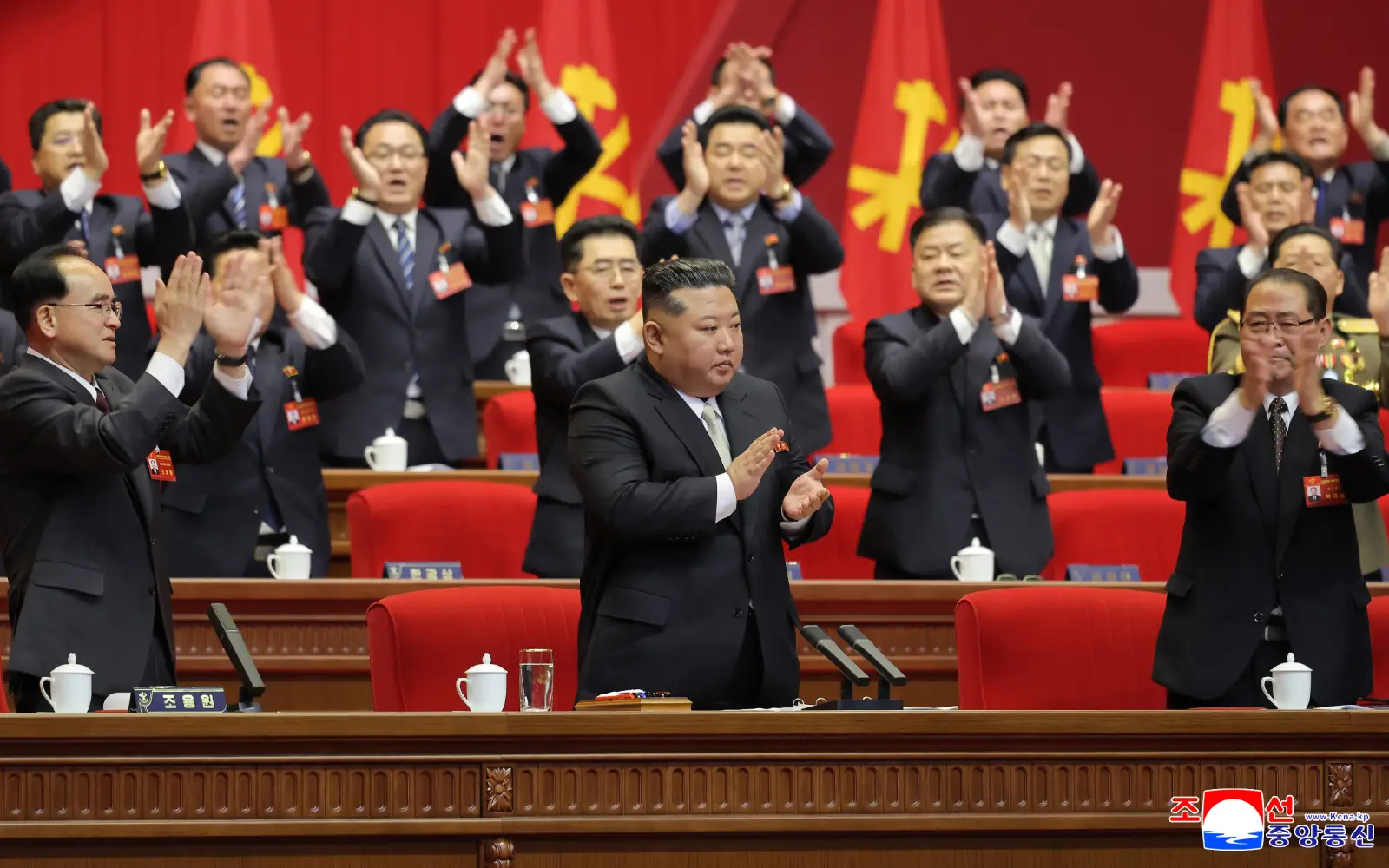
Images released by KCNA showed Kim seated prominently at the centre of the assembly hall, flanked by senior officials and positioned in front of large statues of his father and grandfather, Kim Il Sung, the country’s founding leader.
The visual presentation reinforced the continuity of North Korea’s dynastic leadership, now in its third generation.
The assembly session follows a major ruling party meeting held last month, further consolidating Kim’s authority and setting the stage for future policy decisions.