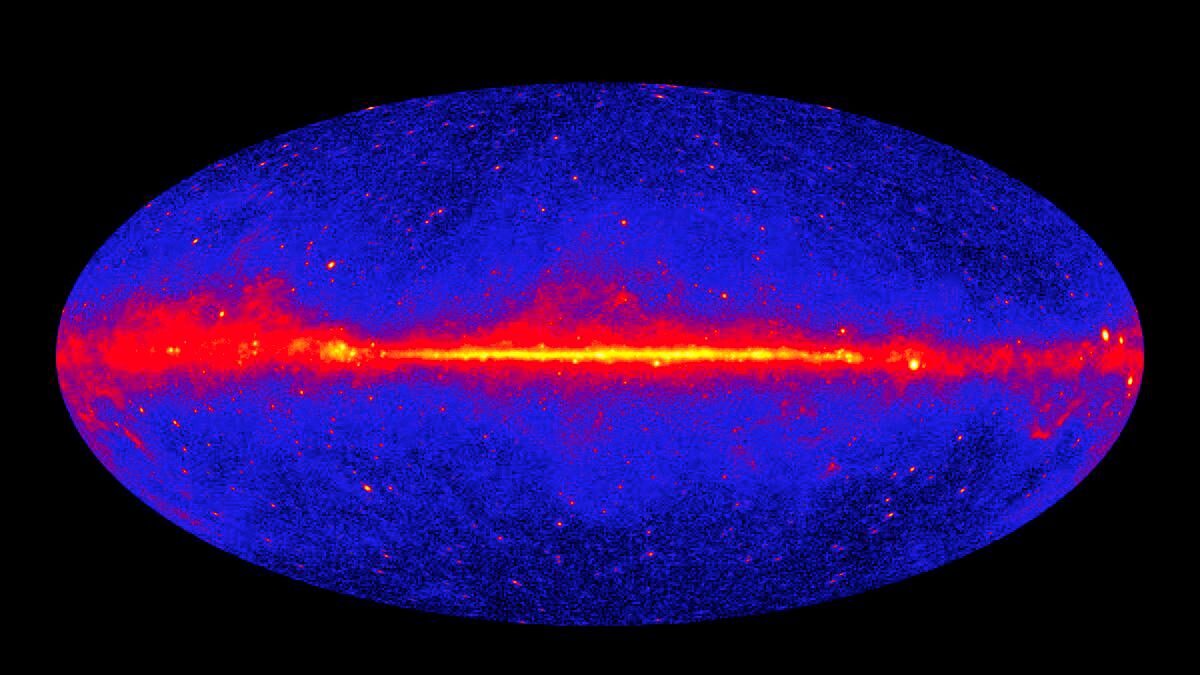
Scientists may be inching closer to solving one of the greatest mysteries in modern physics confirming the existence of dark matter, the invisible substance believed to make up more than a quarter of the universe. Recent studies of a faint gamma-ray glow near the center of the Milky Way could offer the strongest evidence yet of this elusive cosmic material.
While everything visible in the cosmos from stars and planets to dust and humans is made of ordinary matter, it accounts for just 5% of the universe. The remaining 95% consists of dark matter (27%) and dark energy (68%), both unseen yet detectable through their profound gravitational effects.
Because dark matter doesn’t emit, reflect, or absorb light, detecting it directly has long challenged scientists. However, a new study published in Physical Review Letters presents promising evidence based on data from NASA’s Fermi Gamma-ray Space Telescope, which mapped an excess of gamma rays emanating from the heart of our galaxy.
Researchers have proposed two main explanations for this mysterious glow:
- It could be the result of dark matter particles colliding and annihilating each other, releasing gamma rays.
- Or, it may come from millisecond pulsars ultra-dense neutron stars spinning hundreds of times per second and emitting energy across the electromagnetic spectrum.
A comprehensive new analysis using advanced simulations found both theories equally plausible. According to cosmologist Joseph Silk of Johns Hopkins University and the Institute of Astrophysics of Paris, “Our key new result is that dark matter fits the gamma-ray data at least as well as the rival neutron star hypothesis. We have increased the odds that dark matter has been indirectly detected.”
The study’s lead author, astrophysicist Moorits Mihkel Muru of the University of Tartu and the Leibniz Institute for Astrophysics Potsdam, emphasized that although dark matter cannot be seen, its gravitational influence on visible matter is undeniable. “Despite decades of searching, no experiment has yet detected dark matter particles directly,” he said.
The gamma-ray excess was observed across the innermost 7,000 light-years of the Milky Way, a region roughly 26,000 light-years from Earth. Scientists believe dark matter particles, if they are indeed their own antiparticles, could annihilate completely upon collision, producing high-energy gamma rays as a byproduct a hallmark signature of their presence.
Further clarity may come from the Cherenkov Telescope Array Observatory, currently under construction in Chile. Expected to become operational by 2026, it will be the world’s most powerful ground-based gamma-ray observatory, capable of distinguishing between signals generated by dark matter and those from pulsars.
As Silk summarized: “Understanding the nature of dark matter the invisible framework shaping galaxies and the universe itself remains one of the greatest frontiers in physics.”