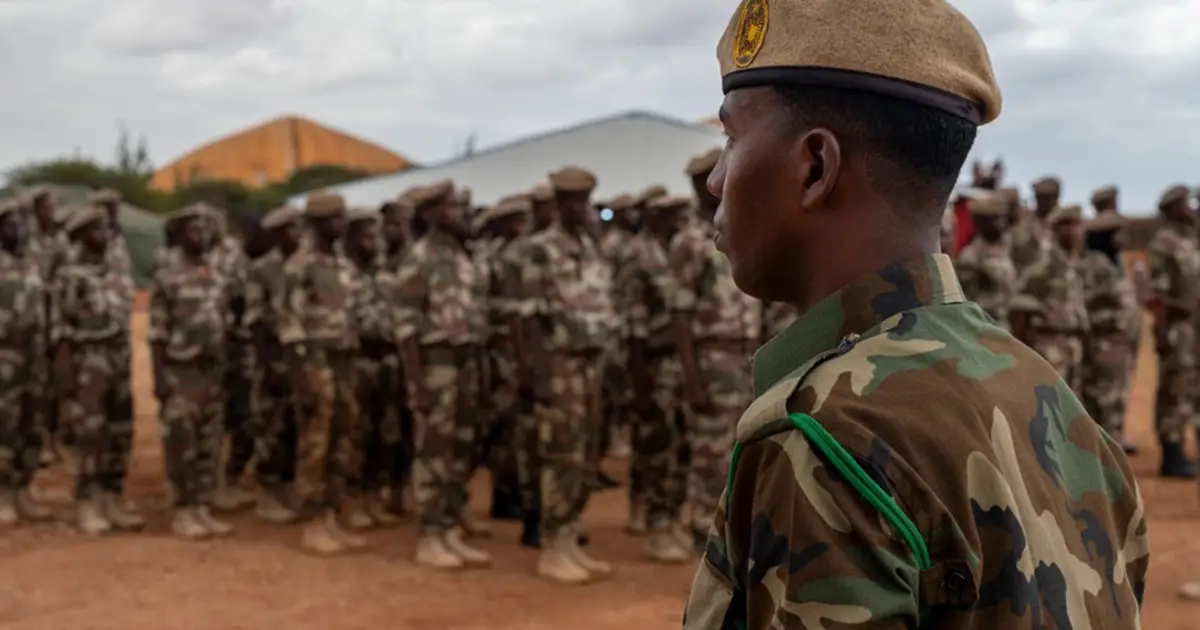
Somalia’s National Army is intensifying operations against al-Shabab militants, implementing what authorities describe as a “total war” strategy to curb attacks on Mogadishu and other key regions.
On the streets of the Somali capital, security measures range from armed personnel in pickup trucks to young men in plain clothes manning checkpoints. Colonel Abdikani Ali Mohamed, a young but prominent security leader, plays a central role in coordinating these efforts, ensuring that suspicious activity is intercepted before it escalates.
“What we have clearly understood is these people (al-Shabab) are always evolving,” Mohamed said. “Their strategies and attack mechanisms continue to grow in complexity.”
Since his election in 2022, President Hassan Sheikh Mohamud has vowed to confront al-Shabab both militarily and financially, targeting the group’s infrastructure and influence among ordinary citizens. Al-Shabab, affiliated with al-Qaida, has long sought to impose strict Islamic law in Somalia and has carried out deadly attacks, including bombings targeting hotels, restaurants, and government buildings.
While major attacks in Mogadishu have become less frequent, sporadic incidents continue to underscore the threat. The last significant attack occurred in August 2024 at Lido Beach, killing dozens. Earlier attempts, including a failed assassination plot against the president in March and a prison attack in October, demonstrate the group’s ongoing capabilities.
Government and African Union forces, supported by international advisers from countries like Egypt and Turkey, have focused on intelligence-driven operations, coordinated through Somalia’s National Intelligence and Security Agency (NISA). Security in Mogadishu now features concrete barriers around hotels and restaurants and fortified zones for the presidency and embassies, with Colonel Mohamed overseeing critical checkpoints.
Beyond the capital, the Lower Shabelle region has become a key battleground. Towns such as Bariire have frequently changed hands between government forces and militants, forcing residents to flee. Daynab Mukhtar Aden, a 65-year-old mother of six, described walking 24 miles from Bariire to safety during one of al-Shabab’s advances. She only returned after government forces regained control and pledged to provide security and rebuild infrastructure.
Military officials emphasize that reclaiming towns in Lower Shabelle is vital for securing Mogadishu. Lt. Col. Abdirahim Mohammed Munye noted, “The enemy fighters (al-Shabab) are sophisticated and skilled in their tactics, which constantly presents new challenges. However, with the help of Allah, we hope to gain the upper hand and liberate our country.”
Despite ongoing threats, Mogadishu is showing signs of recovery. Construction projects are underway, cafes and ice cream parlors are reopening, and neon lights illuminate major streets at night. Longtime residents, like retiree Hajji Abuker Osman, welcome the improved security: “Insecurity has been one of our biggest challenges. It has really improved now.”
As Somalia intensifies its crackdown on al-Shabab, the government hopes that sustained military pressure, combined with intelligence-led operations, will restore stability and enable the capital and surrounding regions to flourish once again.