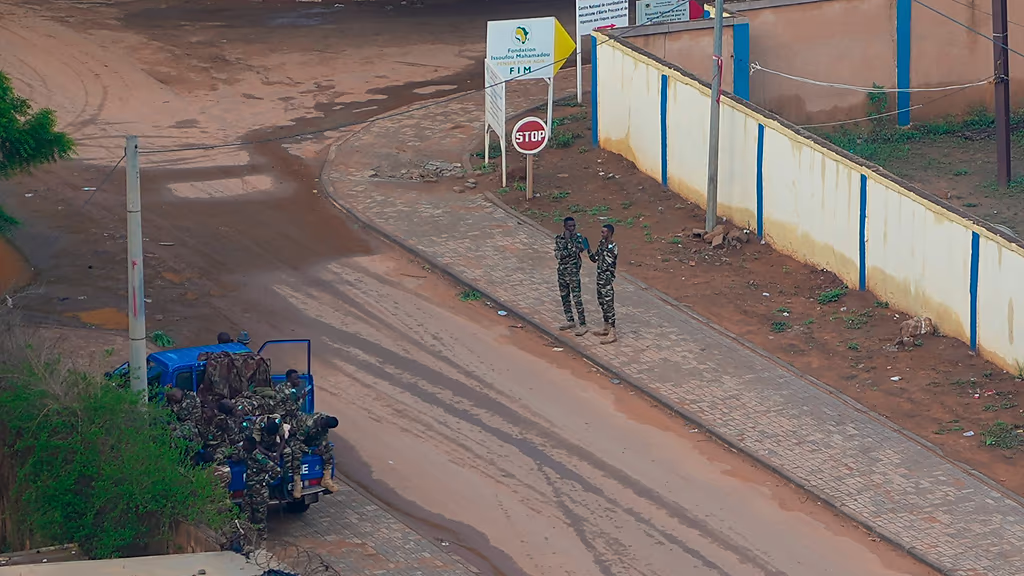
Tillabéri, Niger – The western region of Tillabéri has become the epicentre of violence in Niger, with nearly 1,300 civilian deaths recorded last year amid a growing jihadist threat linked to Al-Qaeda and the Islamic State (IS), according to conflict monitors.
Located along the porous borders with Mali and Burkina Faso, Tillabéri has seen jihadist groups carry out attacks on civilians, government officials, and military forces. “Schools and health centres are closed, and markets are no longer active,” said Amadou Arouna Maiga, coordinator of the Union of Tillabéri for Peace and Security.
Despite taking power in a 2023 coup promising to curb violence, Niger’s military junta has struggled to contain the Islamic State and the Group for the Support of Islam and Muslims (JNIM), Al-Qaeda’s Sahel affiliate. By 2025, Tillabéri had become the deadliest part of the central Sahel for civilians, according to the Armed Conflict Location & Event Data Project (ACLED).
Deadliest Incidents
Last year, nearly half of Tillabéri’s deaths resulted from clashes between Nigerien forces and jihadists, while the remainder were attacks targeting civilians. Some of the most lethal incidents included:
- An attack on a baptism ceremony that killed 22 civilians.
- An assault on a mosque during a sermon that left 71 dead.
- An attack on another mosque claiming 44 lives.
- The killing of 34 soldiers in a separate assault, along with the assassination of two mayors.
ACLED notes that while most violence is perpetrated by jihadist groups, Nigerien forces have also been accused of civilian casualties in some operations. In response, local residents have formed self-defence militias, though these groups are often poorly trained and lightly armed, leaving them vulnerable. At least 25 militia members were killed near the Malian border in February.
Strategic and Economic Factors
The surge in violence is partly attributed to Tillabéri’s strategic location at the crossroads of Niger, Mali, and Burkina Faso, allowing militants to move freely. Jihadists also profit from illegal gold mining across the region, providing funds to arm fighters and sustain operations.
Residents face severe restrictions and economic collapse due to anti-jihadist measures, including a state of emergency, a ban on motorcycles, and the closure of markets and petrol stations. A taxi driver in Téra lamented: “No work, no money, life is very hard.”
Civilians in jihadist-controlled areas are subjected to improvised courts enforcing Islamic law, tributes, and harsh punishments. “Stubborn people and those suspected of collaborating with the army are whipped or executed in public,” a nurse who fled Tillabéri told AFP.
Outlook
Conflict analysts warn that without significant intervention, Tillabéri is unlikely to see a reduction in violence in 2026. ACLED analyst Heni Nsaibia said the combination of expanding jihadist operations, poorly equipped local militias, and the continued targeting of civilians paints a bleak picture for the region’s stability.
As the humanitarian crisis deepens, the population faces not only the threat of death but also the erosion of livelihoods and basic services, making Tillabéri one of the most volatile regions in the Sahel today.