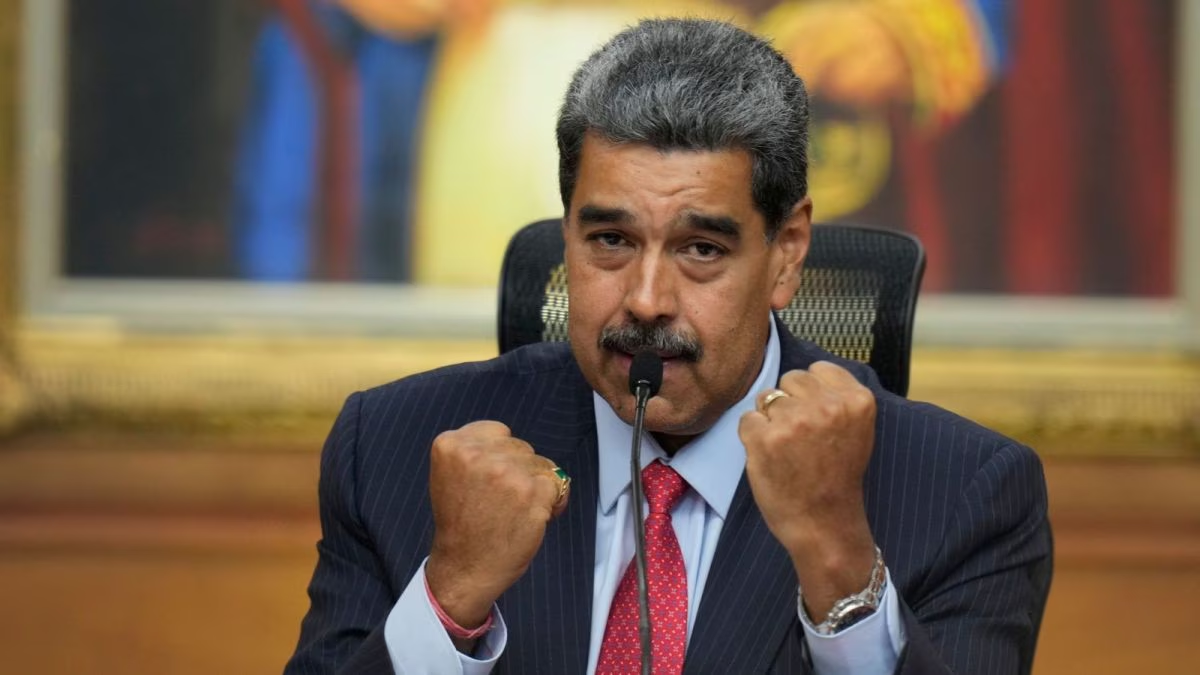
In a major escalation, the United States carried out a military operation in Venezuela overnight, resulting in the capture of long-serving President Nicolás Maduro, according to President Donald Trump. The announcement came early Saturday, following months of U.S. pressure on Maduro over allegations of drug trafficking and election irregularities.
The operation marks the most direct U.S. intervention in Latin America since the 1989 invasion of Panama to remove military leader Manuel Noriega under similar allegations.
Trump confirmed the operation on Truth Social, stating, “The United States of America has successfully carried out a large-scale strike against Venezuela and its leader, President Nicolás Maduro, who, along with his wife, has been captured and flown out of the country.” The U.S. has previously accused Maduro of running a “narco-state” and of manipulating last year’s election, which the opposition claims it won decisively. Maduro, who has been in power since succeeding Hugo Chávez in 2013, has accused Washington of seeking control over Venezuela’s vast oil reserves.
Venezuelan Government Responds
Venezuelan Defense Minister Vladimir Padrino condemned the strikes, calling on citizens to resist. “Free, independent, and sovereign Venezuela rejects with all the strength of its libertarian history the presence of these foreign troops, which have only left behind death, pain, and destruction,” Padrino said in a statement broadcast on state media. “Today we clench our fist in defense of what is ours. Let us unite, for in the unity of the people we will find the strength to resist and to triumph.”
While Maduro faces criticism from other Latin American governments for alleged election fraud, direct U.S. intervention has evoked strong regional opposition, recalling historical interventions. The Venezuelan opposition, led by recent Nobel Peace Prize laureate María Corina Machado, has not issued an official comment regarding the events.
Explosions and Unrest in Caracas
Explosions and aerial activity were reported in Caracas and surrounding states, including Miranda, Aragua, and La Guaira, in the early hours of Saturday. Eyewitnesses described blasts, black smoke, and bright flashes in the sky for roughly 90 minutes, causing widespread shock among residents. A power outage affected parts of southern Caracas, near major military installations.
Carmen Marquez, a local resident, said, “Flare-like lights were crossing the sky and then explosions could be heard. We’re worried about what’s coming next. We don’t know anything from the government, only what state television reports.”
International Reactions
Venezuelan allies, including Cuba and Iran, condemned the U.S. strikes. Tehran called the attacks “a blatant violation of national sovereignty and territorial integrity” and urged the United Nations Security Council to intervene.
Background and U.S. Operations
The Trump administration has previously accused Maduro of enabling drug trafficking into the U.S. and has carried out targeted strikes on vessels suspected of transporting narcotics. Trump has repeatedly indicated the potential for ground operations and imposed expanded sanctions, alongside plans for a Venezuelan oil blockade.
Legal experts have questioned the authority for these actions, as past strikes on suspected drug vessels have resulted in significant casualties, and the legality under international and U.S. law remains contested.
The situation in Venezuela remains fluid, with details of the operation and Maduro’s status still emerging. The U.S. has promised further updates in a press briefing at Mar-a-Lago.