
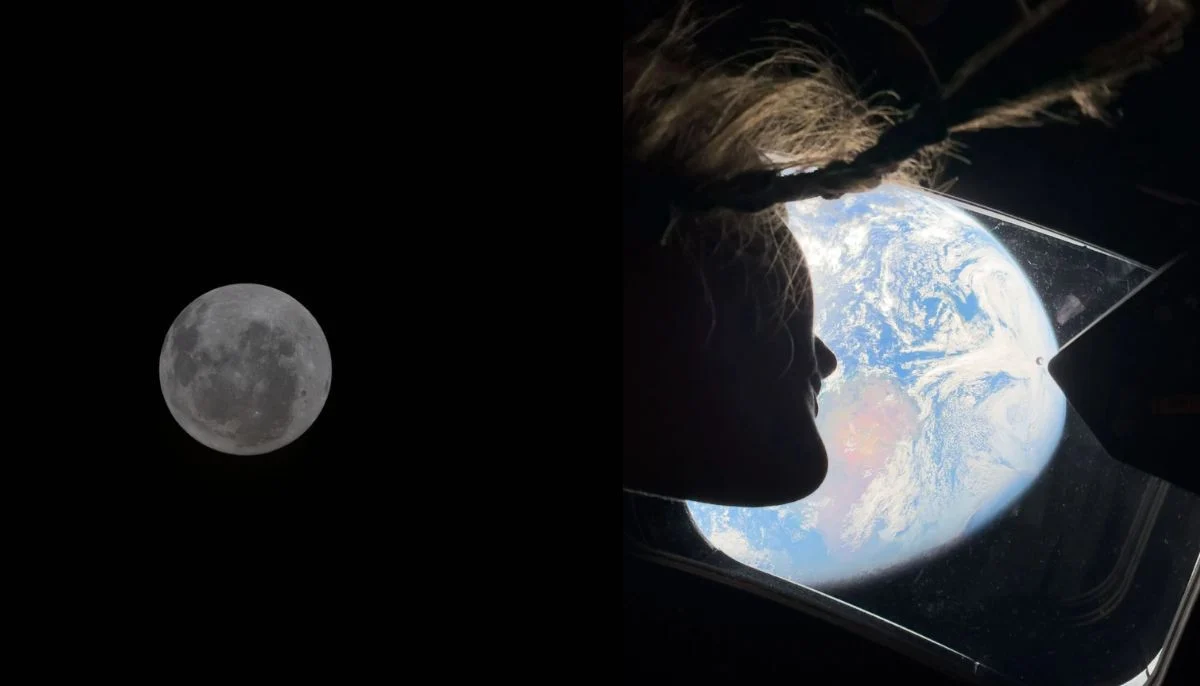
The Artemis 2 astronauts have entered the final phase of their lunar approach, marking a historic milestone as the Moon’s gravity begins to exert a stronger pull on the Orion spacecraft than Earth.
As of Monday 0442 GMT, the crew was approximately 39,000 miles (63,000 kilometers) from the Moon and 232,000 miles from Earth, according to a NASA official during the agency’s livestream of the mission. This milestone sets the stage for the first human lunar flyby since 1972, making this one of the most ambitious crewed missions in decades.
“This mission marks the first time the entire Orientale basin has been seen with human eyes,” NASA said, highlighting the significance of newly observed lunar features.
Historic Firsts for the Crew
The Artemis 2 mission carries several historic achievements.
- Victor Glover will become the first person of color to fly around the Moon.
- Christina Koch will become the first woman to accomplish the lunar flyby.
- Jeremy Hansen will be the first non-American astronaut to reach this milestone.
Mission commander Reid Wiseman joins the crew in documenting the lunar surface throughout their flyby.
“It’s very distinctive and no human eyes previously had seen this crater until today, really, when we were privileged enough to see it,” Koch told Canadian children during a live Q&A hosted by the Canadian Space Agency, referring to the Orientale basin.
Exploring the Far Side and Solar Eclipse
The astronauts have begun observing previously unseen lunar terrain, including the Orientale basin, a massive bullseye-shaped crater on the Moon’s far side.
Toward the end of the flyby, the crew is set to witness a solar eclipse, where the Moon will block the Sun, revealing the solar corona. The astronauts will also test their Orion Crew Survival System (OCSS) spacesuits, which provide up to six days of breathable air and are being worn in space for the first time.
“This is the first time astronauts have ever flown on this spacecraft before. That’s what we’re most interested in getting data from,” NASA Administrator Jared Isaacman said, emphasizing the mission’s importance for future Artemis missions.
Record-Breaking Distance from Earth
While the crew will not land on the lunar surface, they are expected to surpass the record for the farthest humans have traveled from Earth. NASA officials noted that the data collected during this flyby is crucial for planning subsequent missions, including Artemis 3 in 2027 and the Artemis 4 lunar landing in 2028.
“They will be on the far side of the Moon, they will eclipse that record, and we’re going to learn an awful lot about the spacecraft,” Isaacman said.
The crew has already completed a manual piloting demonstration and reviewed key lunar features to photograph and study during their flyby. Life support systems and spacecraft functionality remain a primary focus as the mission unfolds.

