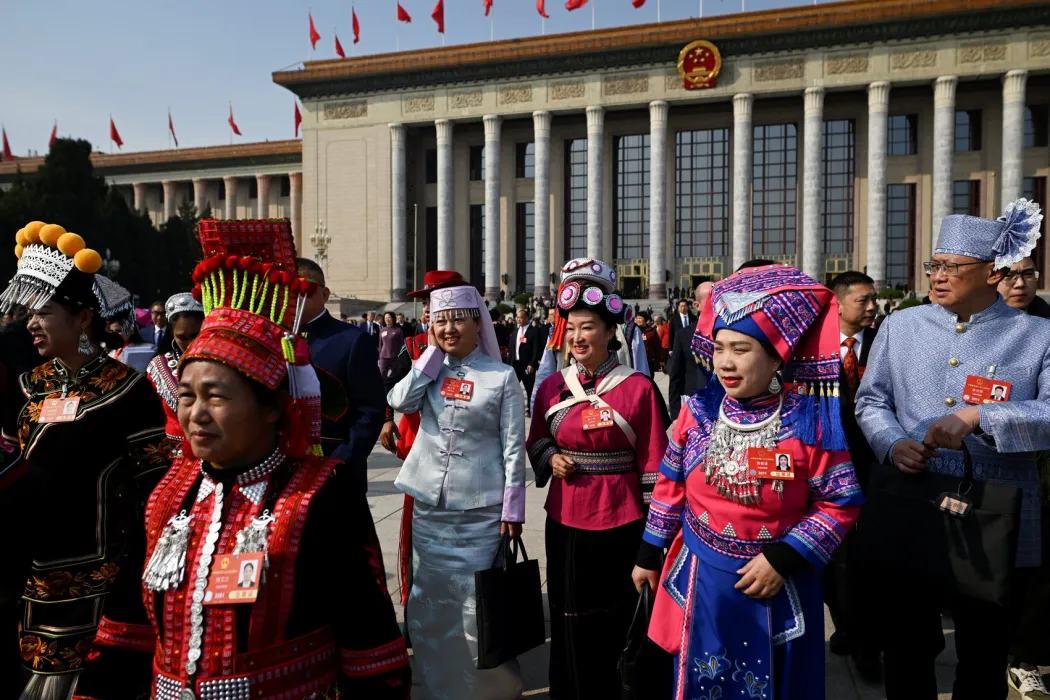
China has passed a sweeping new law aimed at promoting “ethnic unity,” but critics warn it could further undermine the rights of minority groups in the country.
The law, approved Thursday at the National People’s Congress in Beijing, seeks to integrate the 56 officially recognized ethnic groups dominated by the Han Chinese through education, housing, and community policies. It mandates that all children be taught Mandarin from before kindergarten through the end of high school, limiting the use of minority languages such as Tibetan, Uyghur, and Mongolian in school curricula.
Supporters in Beijing argue that teaching Mandarin will improve job prospects for minority children and foster modernization through greater national cohesion. However, academics and human rights advocates say the law represents a continuation of state-led assimilation policies that erode ethnic diversity.
“The children of the next generation are now isolated and brutally forced to forget their own language and culture,” said Magnus Fiskesjö, associate professor of anthropology at Cornell University. Allen Carlson, associate professor of government at the same university, noted that the law signals that “non-Han peoples must do more to integrate themselves with the Han majority, and above all else be loyal to Beijing.”
The law also provides a legal basis to prosecute parents or guardians who instill views deemed “detrimental” to ethnic harmony and calls for “mutually embedded community environments,” a provision critics warn could lead to the dismantling of minority-heavy neighborhoods.
China’s push for “sinicisation” of ethnic groups dates back to the late 2000s and has intensified under President Xi Jinping. Minority regions such as Tibet, Xinjiang, and Inner Mongolia have faced increasing restrictions on language, religion, and cultural practices. In Xinjiang, human rights groups estimate that over a million Uyghur Muslims have been detained in so-called “re-education” camps, while in Tibet authorities have controlled monasteries and arrested monks to enforce loyalty to Beijing.
Protests have occurred in response to previous language policies. In 2020, ethnic Mongolians in northern China held rallies and withheld children from school in opposition to Mandarin-focused curricula. Authorities responded with crackdowns on dissent.
While China’s constitution guarantees that each ethnicity has the right to use and develop its own language and self-govern, critics say the new law formalizes Xi’s assimilationist agenda. Ian Chong, professor at the National University of Singapore, stated:
“Minority languages and cultures are portrayed as backward and impediments to advancement, reinforcing the narrative that they must conform to the Han majority.”
The law underscores Beijing’s continued emphasis on national unity and development but raises concerns among observers about the future of China’s ethnic minority communities.