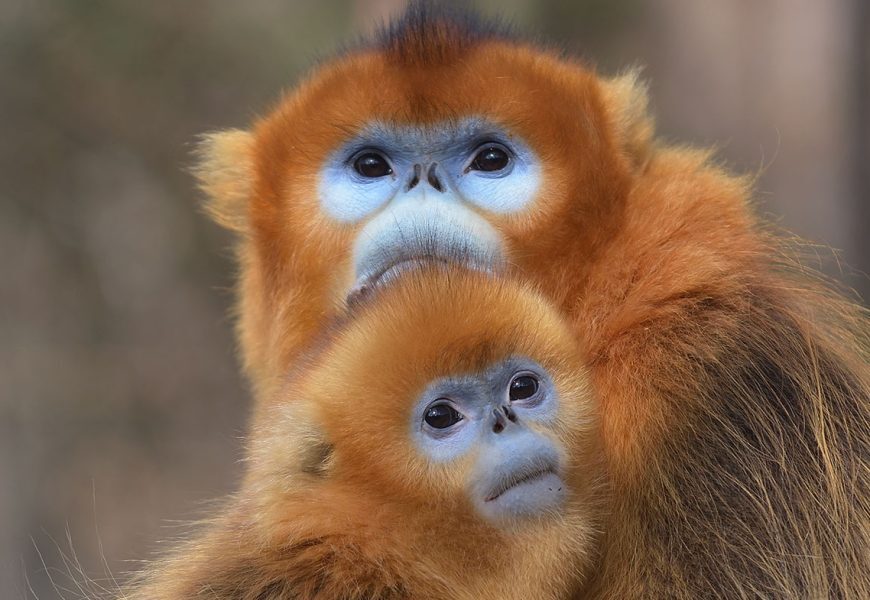
With their striking golden-orange fur, pale blue faces, and thick coats that protect them from the icy mountains of central China, golden snub-nosed monkeys are among the country’s most distinctive and endangered animals. Now, these rare primates are taking on a new role as international ambassadors joining the ranks of China’s iconic giant pandas in representing the nation abroad.
For the first time, China has loaned golden snub-nosed monkeys to European zoos under a 10-year agreement managed by the same government body that oversees panda exchanges. The move sometimes referred to as an extension of “panda diplomacy” has been met with both excitement and debate. While many celebrate the opportunities for scientific collaboration and conservation, others have raised ethical concerns about the welfare of the animals involved in long-distance relocations.
In April, three of the monkeys arrived at France’s Beauval Zoo in Saint-Aignan, part of events marking 60 years of diplomatic relations between France and China. Another trio landed a month later at Pairi Daiza Zoo in Belgium, where visitors waved Belgian and Chinese flags to welcome them.
Following a quarantine period, both groups made their public debut and are reportedly adapting well to their new environments the first time these monkeys have lived outside Asia.
At Pairi Daiza, the enclosure for Liu Yun, Lu Lu, and Juan Juan is designed to reflect Chinese culture, complete with traditional gazebos, red pillars, and tiled roofs. “The diplomatic aspect comes from this cultural awareness,” said zoo spokesperson Johan Vreys.
According to Anaïs Maury, communications director at Beauval Zoo, the institutions plan to collaborate with Chinese researchers on joint studies and conservation efforts “similar to those already established for pandas.”
A Legacy of Animal Diplomacy
Both giant pandas and golden snub-nosed monkeys are protected national treasures that can only be loaned abroad with approval from China’s central government. While pandas have long symbolized China’s soft power on the world stage, monkeys hold a deeper cultural legacy appearing in classical art, folklore, and literature, such as the legendary Monkey King from Journey to the West.
China’s use of animals in diplomacy dates back to the 1950s. The first panda ambassadors, Ping Ping and Qi Qi, were sent to the Soviet Union in 1957 to mark the 40th anniversary of the October Revolution. In 1972, two pandas were gifted to the United States after President Richard Nixon’s landmark visit to Beijing, ushering in a new era of cultural diplomacy.
By 1984, China shifted from gifting to leasing pandas, with revenues directed toward wildlife conservation and research. Today, long-term agreements ensure funds support habitat preservation and breeding programs.
However, experts caution that the benefits to conservation do not always translate to individual animal welfare. Jeff Sebo, a bioethics researcher at New York University, notes that relocation and repatriation can cause significant stress to animals.
Despite such concerns, historians argue that animal diplomacy continues to play a valuable role in softening global perceptions of China. “Pandas and now perhaps these golden monkeys offer a positive and non-political connection,” said James Carter of Saint Joseph’s University.
As the golden snub-nosed monkeys begin their new lives in France and Belgium, they may soon join pandas as symbols of China’s evolving “wildlife diplomacy” bridging nations through conservation, culture, and curiosity.