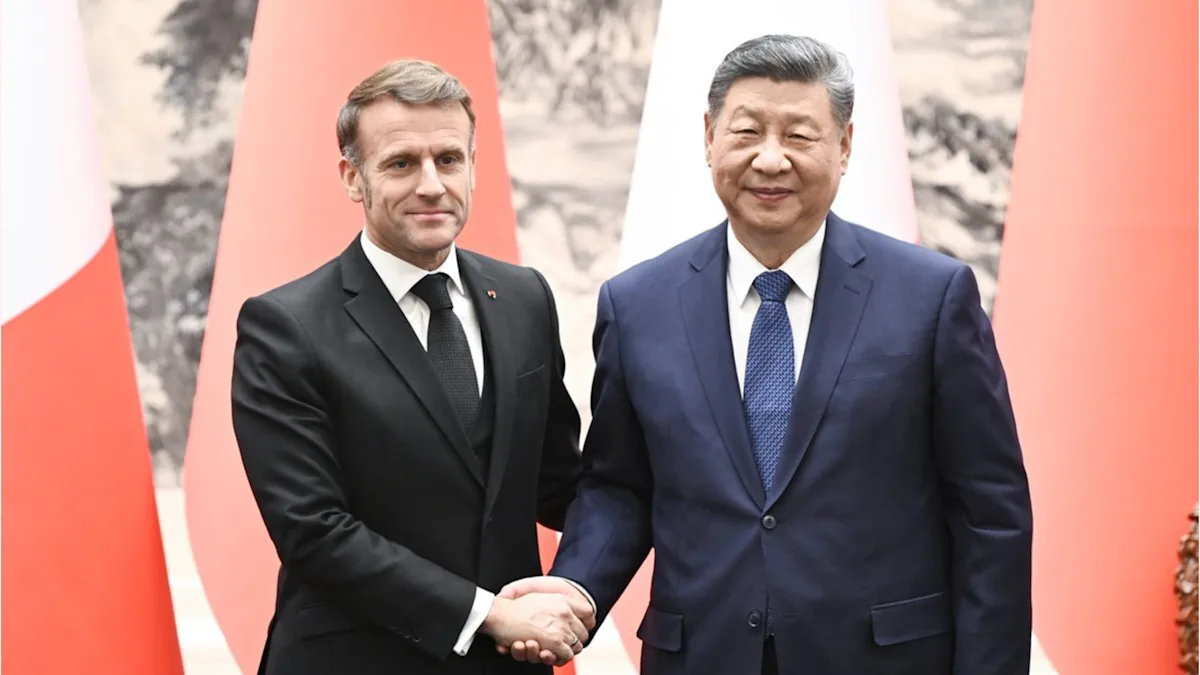
Chinese President Xi Jinping extended a rare diplomatic gesture to French President Emmanuel Macron on Friday, accompanying him to the southwestern city of Chengdu in a move that underlines Beijing’s strategic focus on strengthening ties with Paris within the European Union.
The high-profile visit, Macron’s fourth state trip to China, stands out even against Xi’s engagements with major world leaders. Notably, when former U.S. President Donald Trump visited Beijing in 2017, his trip remained confined to the capital despite the red-carpet treatment and a private tour of the Forbidden City. Macron’s Chengdu stop therefore signals China’s intent to elevate France as a key interlocutor in Europe.
Yet, behind the warm optics and symbolic gestures, the visit has so far yielded limited concrete outcomes. Analysts say China is leveraging Macron’s presence to reinforce its diplomatic standing amid heightened global economic uncertainty driven by Trump’s tariffs, while the French president seeks to project international statesmanship during a challenging period at home.
Limited Agreements, High Expectations
Investors and policymakers had been watching closely to see if Macron’s visit accompanied by top executives from major French corporations would produce major commercial deals or progress on EU-China trade tensions. Instead, Thursday’s meetings in Beijing resulted in just 12 cooperation agreements covering areas such as population ageing, nuclear energy, and panda conservation. No financial details were disclosed.
“I think they thought Xi would be in a position to offer a lot because Europe is preparing this economic security doctrine,” said Alicia Garcia-Herrero, senior fellow at the Bruegel think tank. She added that France likely expected Beijing to make concessions, but “nope.”
Even so, Macron enjoyed a strong public reception at Sichuan University, where students thronged around him ahead of a speech urging China to reflect on its role in a transforming global order.
“We are at a moment of unprecedented rupture,” Macron warned, describing a world where multilateral cooperation is fracturing. He pushed back against narratives portraying Europe as weakened or irrelevant, calling such claims “a fabrication.”
Beijing’s Calculated Caution
Despite the public diplomacy, Beijing remains cautious about offering Paris any major concessions that could complicate its broader geopolitical calculus.
A long-anticipated 500-aircraft Airbus deal did not materialize, with analysts noting that such a move would limit China’s leverage in ongoing trade discussions with Washington. Similarly, Xi refrained from easing market conditions for French cognac or pork exports, careful not to weaken Beijing’s hand in negotiations with the EU over tariffs on Chinese-made electric vehicles.
Nor did China offer a diplomatic breakthrough on the war in Ukraine. With Beijing reaffirming its alignment with Russia, Macron is unlikely to return to Europe with any meaningful shifts in China’s position.
This pattern reflects a broader trend: recent visits by European leaders, including Spain’s King Felipe VI and German Finance Minister Lars Klingbeil, have also concluded with few concrete achievements.
EU Divisions and China’s Strategic Positioning
Chinese government advisers, speaking anonymously, suggested Beijing believes it holds the upper hand in its trade standoff with Brussels. Officials say China is waiting for the EU to abandon its tariff approach and accept a minimum price framework for Chinese EVs a proposal Beijing views as more favourable.
The EU remains divided on the issue. France voted in favour of tariffs on Chinese electric vehicles, while Germany, the bloc’s economic powerhouse, opposed them.
Such fractures present Beijing with opportunities. Although Xi did not raise the prospect of an EU-China trade deal with Macron, Chinese officials have floated the idea to other European member states in recent weeks despite the European Commission saying it has no plans to revive trade negotiations.
A Diplomatic Showcase, Not a Policy Shift
While Macron’s visit has enhanced Beijing’s diplomatic profile and allowed France’s president to reinforce his international presence, the trip has not delivered the major commercial or geopolitical breakthroughs either side might have hoped for.
Instead, the journey highlights the complexities shaping EU-China relations: economic interdependence tempered by political constraints, competing strategic priorities, and growing divisions within Europe over how to engage with Beijing.
With both sides navigating shifting global dynamics, the optics of warmth and cooperation may be the most substantive outcome of the Macron-Xi meeting at least for now.