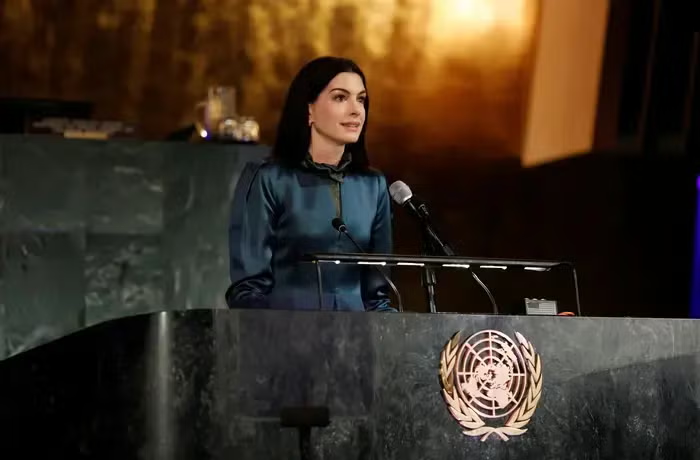
The United Nations has opened the seventieth session of the Commission on the Status of Women, with Secretary-General António Guterres urging world leaders to strengthen access to justice for women and girls and address persistent gender inequality worldwide.
Speaking at the opening session on Monday, Guterres emphasized that gender equality has always been tied to the distribution of power in societies and institutions.
“Gender equality is, and always has been, a question of power,” he said.
Focus on Access to Justice
This year’s session is centered on improving access to justice for women and girls through inclusive and equitable legal systems. Delegates will discuss strategies to eliminate discriminatory laws, policies, and practices while addressing structural barriers that prevent women from accessing justice.
The global forum brings together government representatives, civil society organizations, and policy experts to assess progress and identify new approaches to advancing women’s rights.
Progress Won Through Advocacy
Guterres highlighted that gains in women’s rights have historically been achieved through sustained advocacy and activism.
“Not a single step forward for women’s rights has ever been given,” he told delegates. “It has been won. Won by generations of women and girls, advocates and activists, community leaders and justice seekers.”
Despite decades of advocacy, he noted that significant disparities remain in legal protections for women.
According to the Secretary-General, women globally hold only about 64 percent of the legal rights enjoyed by men, illustrating the scale of inequality that still exists in many parts of the world.
“Here we are, well into the 21st century, yet justice remains a distant dream for millions upon millions of women and girls,” he said, warning that discriminatory laws and entrenched patriarchal norms continue to hinder progress.
Women’s Participation in Peace Processes
The UN chief also expressed concern over the continued exclusion of women from peace negotiations and transitional justice efforts.
Research shows that peace agreements are more durable and societies recover more effectively when women participate meaningfully in peace processes. However, Guterres said global efforts have yet to fully translate those findings into practice.
“Inclusion is proclaimed, yet women are absent from negotiating tables. Protection is pledged, yet sexual violence persists with impunity,” he stated.
Impact of Conflict on Gender Equality
The session is taking place amid ongoing conflicts across several regions. Sima Bahous, Executive Director of UN Women, warned that war and instability are further worsening gender inequality.
Bahous stressed that conflict environments often intensify violence, displacement, and discrimination against women and girls.
“Gender inequality is compounded by the evils of war and conflict,” she said, calling for renewed diplomatic efforts to resolve crises and reduce violence in regions including the Middle East, Africa, and beyond.
Global Effort to Advance Gender Equality
The Commission on the Status of Women remains one of the UN’s most important platforms for advancing gender equality and women’s empowerment. Outcomes from the session are expected to influence global policies aimed at strengthening legal protections, improving justice systems, and promoting equal rights for women and girls.
Delegates are expected to hold a series of high-level discussions and policy dialogues throughout the session as the international community continues to address the challenges surrounding gender equality and justice.