
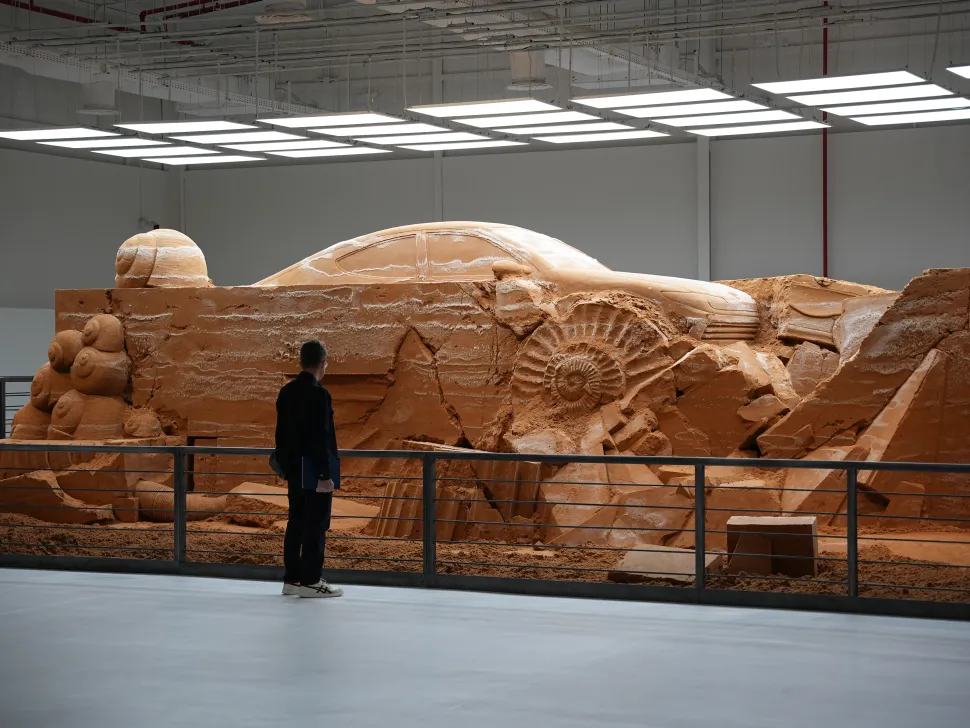
Riyadh, Saudi Arabia – The third edition of the Diriyah Contemporary Art Biennale opened with a striking desert procession through the Wadi Hanifah valley, setting the tone for a global exploration of migration, memory, and ancestral knowledge.
Running until May 2nd at JAX, near the UNESCO World Heritage site At-Turaif, the Biennale features 68 artists from 37 nations, each engaging with themes that connect the Arab world to broader global narratives.
Yussef Agbo-Ola’s “AGBA: 8 Stone Cave”
Nigerian-British artist Yussef Agbo-Ola presents a sacred sculpture titled AGBA: 8 Stone Cave, blending Yoruba concepts with Saudi traditions. The work incorporates Al-Qatt Al-Asiri geometric wall art, historically created by women of the Aseer region, alongside references to Saudi cultural imagery such as the Flower Men’s herbs, the hawksbill turtle, and weaver birds.
Constructed with clay bricks inspired by insect exoskeletons, the pavilion embodies Agbo-Ola’s philosophy of ancestral knowledge:
“For me, I feel like our ancestors are not just human. A river can be an ancestor, a mountain, a plant. We have all of these ancestors that are always all around us that we can communicate with.”
Dineo Seshee Bopape’s Immersive Installation
South African artist Dineo Seshee Bopape offers an immersive installation exploring wind, migration, and memory. Drawing on the practice of go fiela mogotha sweeping the yard she highlights disappearing traditions as acts of earth stewardship.
Her installation features contributions from Noria Mabasa and Andrew Tshabangu, weaving together references to rain-making practices of Southern Africa, celestial beings, and ancestral presences.
“The work has references to rain-making practices of Southern Africa, beings that are known to be related to those practices, beings in the celestial skies, and also beings that have incarnated in human forms,” Bopape explained.
A Global Dialogue Rooted in Place
The Biennale’s opening procession and diverse installations underscore the event’s mission: to situate Saudi Arabia within a global artistic dialogue while celebrating local traditions and ancestral wisdom. By merging contemporary art with cultural heritage, the Biennale positions Riyadh as a hub for creative exchange and innovation.
Conclusion
With its desert procession and powerful installations, the Diriyah Contemporary Art Biennale 2026 invites audiences to reflect on migration, memory, and the interconnectedness of ancestral traditions. As artists from across the world converge in Riyadh, the Biennale offers a transformative space where heritage and contemporary art meet.

