
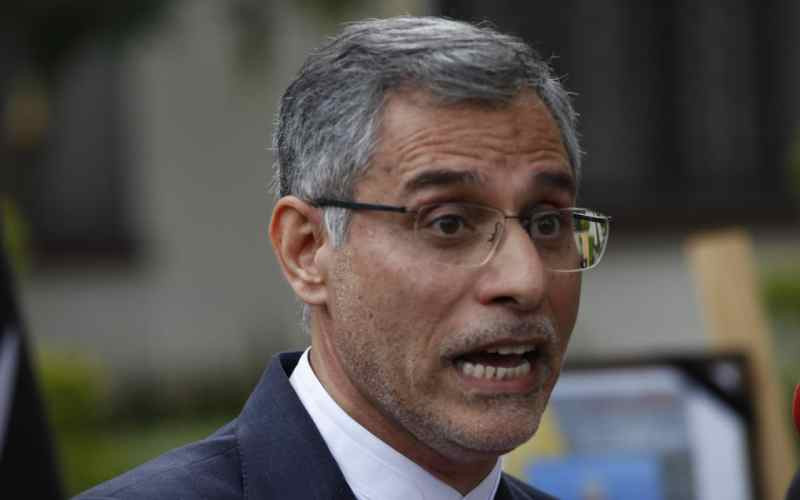
In a recent press briefing in Nairobi, Iran sought to allay fears of any potential threats to Kenya amidst escalating tensions in the Middle East. Dr. Ali Gholampour, the Iranian Ambassador to Kenya, emphasized that the country does not host U.S. military facilities capable of striking Iran, and therefore is not a target in the ongoing conflict.
The statement comes as Iran has launched a series of retaliatory missile strikes across the Middle East following Saturday’s airstrikes by the United States and Israel, which killed Iran’s supreme leader Ayatollah Ali Khamenei and other top officials. Countries affected by these attacks include the United Arab Emirates, Qatar, Saudi Arabia, Iraq, Oman, Kuwait, Jordan, and Bahrain.
During the briefing, Ambassador Gholampour condemned the U.S. and Israeli strikes, describing them as a “fragrant violation of international peace and stability” and affirming Iran’s right to self-defense. He warned that the United States and Israel would bear full responsibility for the consequences of their actions, calling on the United Nations to intervene to prevent further escalation.
“This country does not provide a U.S. military facility with a magnitude to attack Iran,” he stated, reassuring Kenyan citizens and authorities of their safety.
The escalating conflict has led to significant disruptions in regional air travel, with several countries including Iran, Iraq, Israel, Syria, Kuwait, and the UAE partially closing their airspace. Kenya Airways has temporarily suspended flights to Dubai and Sharjah as a precautionary measure.
Kenyan President William Ruto condemned the missile strikes, highlighting the dangers of the regionalization of the conflict. “At this defining and perilous moment in global history, longstanding multilateral institutions remain indispensable frameworks for the resolution of the current crisis in the Middle East,” Ruto said, calling for diplomatic engagements to de-escalate tensions.
Prime Cabinet Secretary Musalia Mudavadi also issued a travel advisory urging Kenyans in or transiting through the Middle East to exercise caution.
Meanwhile, the United Nations Security Council convened an emergency meeting, where Iran’s envoy accused the U.S. and Israel of possible war crimes targeting civilians. UN Secretary-General Antonio Guterres cautioned that continued military action carries the risk of triggering uncontrollable chain reactions across the region.
As tensions mount, Kenya continues to navigate the situation cautiously, balancing regional security concerns with assurances from Iran that the country remains outside the immediate scope of conflict.

