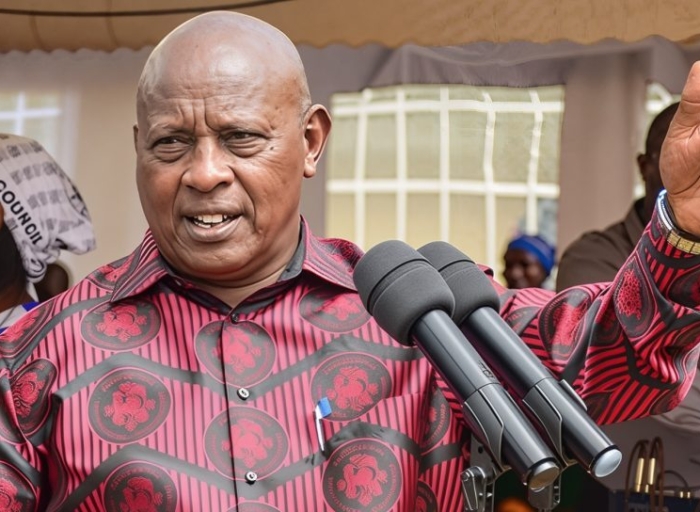
After his expulsion from the National Assembly’s Budget and Appropriations Committee, Kiharu Member of Parliament Ndindi Nyoro retreated from the political spotlight, choosing instead to focus on his constituents with renewed energy and determination.
Quiet Retreat, Renewed Focus
While the impeachment of then Deputy President Rigathi Gachagua dominated national headlines, Nyoro deliberately avoided the frenzy. He measured his public statements carefully and remained steadfastly focused on the mandate entrusted to him by the people of Kiharu.
Observers noted that Nyoro appeared to be a man on a mission unmoved by political theatre and determined to deliver tangible results to his constituency, even after falling out of favor with powerful figures at State House.
Development Projects Amid Political Tensions
On March 19, 2025, just weeks after his removal from the Budget Committee, Nyoro unveiled newly constructed administrative offices in Mjini, funded by the National Government Constituency Development Fund (NG-CDF). The project was designed to house multiple government offices under one roof, including those of the Assistant County Commissioner, Chiefs, Assistant Chiefs, and the Office of Social Services & Lands Board.
The launch, however, was marred by political tensions, with local government officials boycotting the event. Despite the setback, Nyoro pressed on, underscoring his commitment to improving service delivery.
Accusations of Favoritism
Nyoro’s development record has long attracted criticism from fellow MPs. Some accused him of directing disproportionate national resources to Kiharu during his tenure as Budget Committee chair.
On a TV interview on January 21, 2026, Suna East MP Junet Mohamed repeated claims that Nyoro unfairly favored his constituency. Similarly, Nakuru Town East MP David Gikaria argued that Nyoro’s education initiatives created unrealistic expectations for other lawmakers.
Yet NG-CDF data paints a different picture:
- Over twelve years, Kiharu received Ksh.1.53 billion, while Suna East received Ksh.1.47 billion.
- Adjusted for population, Suna East residents benefited more per capita (Ksh.12,048) compared to Kiharu (Ksh.7,840).
This analysis suggests that accusations of favoritism may be overstated.
Education Initiatives
In January 2026, Nyoro announced a major reduction in day secondary school fees under the Kiharu Masomo Bora Programme, lowering fees from Ksh.1,000 to Ksh.500 per term for learners from Grade 10 to Form Four. The initiative is expected to benefit more than 12,000 students across 65 schools, making education more affordable for thousands of families.
While critics linked the move to unfair resource allocation, others, including Kericho Senator Aaron Cheruiyot, defended Nyoro, noting that regional disparities in school requirements and funding make uniform implementation difficult nationwide.
National Impact and Inspiration
Nyoro’s success in Kiharu has sparked a broader national conversation about resource allocation and accountability. Former Deputy President Rigathi Gachagua, inspired by Nyoro’s achievements, has repeatedly highlighted underdevelopment in Northern Kenya, attributing it to poor leadership rather than lack of resources.
Lawyer and politician Willis Otieno has also used his platform to spotlight neglected constituencies, contrasting Nyoro’s tangible results with the failures of other MPs.
Conclusion
Despite relentless political attacks, Ndindi Nyoro remains focused on his constituents improving livelihoods, expanding education, supporting businesses, and safeguarding the future of Kiharu. His model of development has not only transformed his constituency but also ignited a national debate on equity, accountability, and the true purpose of leadership.
For Nyoro, the mission is clear: serve the people who entrusted him with their votes. And that, he insists, is all that truly matters.