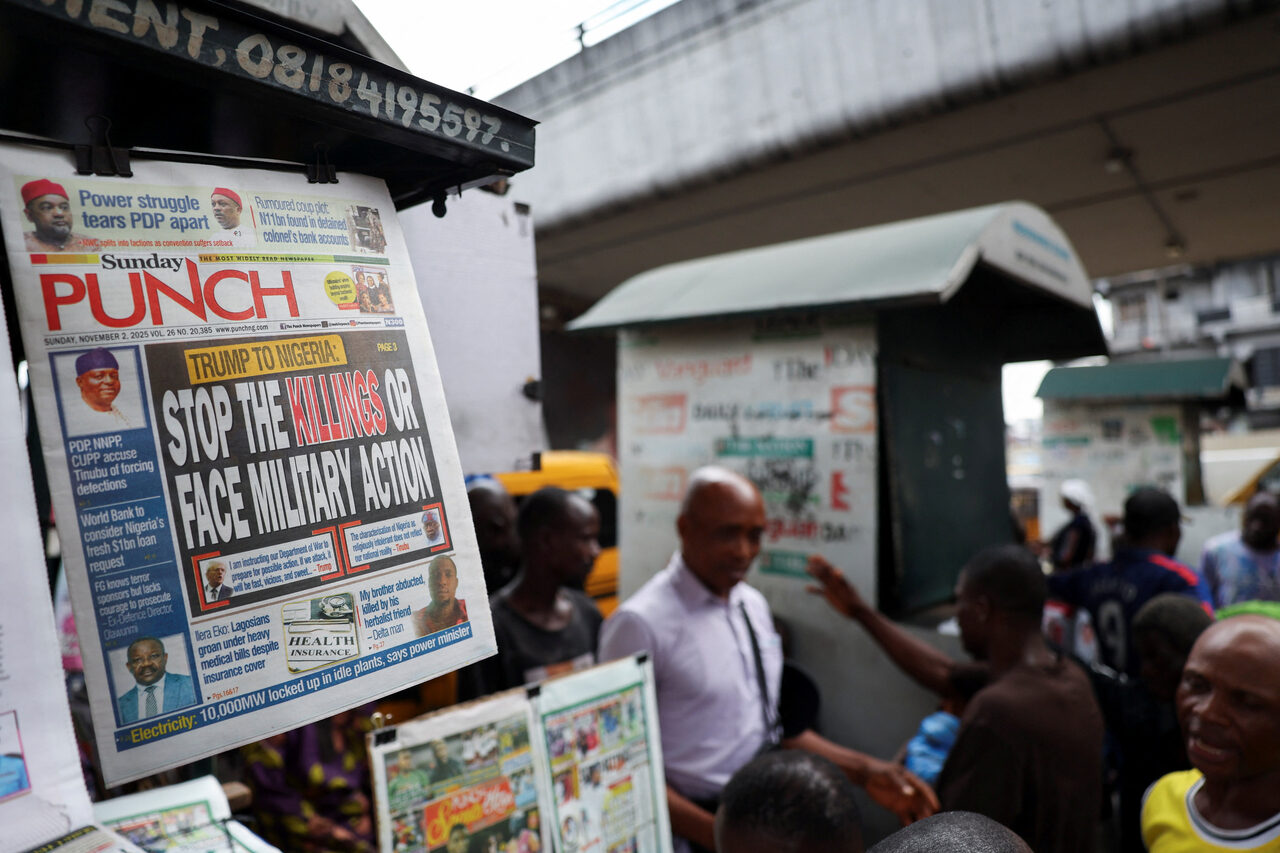
Nigeria has expressed readiness to welcome assistance from the United States in combating Islamist insurgents, provided its territorial integrity is respected. The statement comes in response to former U.S. President Donald Trump’s threats of potential military intervention over what he described as the “killing of Christians” in the West African nation.
Trump said on Saturday that he had directed the U.S. Defense Department to prepare for swift action in Nigeria should the government fail to curb attacks on Christians. Speaking to reporters aboard Air Force One on Sunday, Trump suggested that the U.S. could deploy troops or carry out air strikes but offered no specific details, saying only, “I envisage a lot of things.”
Reacting to Trump’s remarks, Daniel Bwala, an adviser to Nigerian President Bola Tinubu, told Reuters that Nigeria welcomes cooperation with Washington as long as its sovereignty is not undermined.
“We welcome U.S. assistance as long as it recognises our territorial integrity,” Bwala said.
Despite Trump referring to Nigeria as a “disgraced country,” Bwala sought to downplay diplomatic tensions, expressing optimism that dialogue between the two leaders could strengthen joint efforts to fight terrorism.
“We don’t take it literally because we know Donald Trump thinks well of Nigeria,” Bwala added. “Once the two leaders meet, there will be positive outcomes in our shared resolve to combat terrorism.”
Insurgency and Religious Violence in Nigeria
Nigeria, a nation of more than 200 million people, is split between a largely Muslim north and a predominantly Christian south. For over 15 years, extremist groups such as Boko Haram and Islamic State West Africa Province (ISWAP) have carried out deadly attacks, killing thousands and displacing millions.
While Christians have been among the victims, experts note that most casualties are Muslims living in the insurgents’ strongholds in the northeast. Beyond jihadist violence, central and northwestern regions also experience recurring clashes between herders and farmers, along with bandit attacks targeting entire villages.
Bwala emphasized that Nigeria’s counterterrorism operations are non-discriminatory:
“Nigeria does not discriminate against any tribe or religion in the fight against insecurity. There is no Christian genocide,” he said.
Complex Dynamics Behind the Violence
According to Ladd Serwat, a senior Africa analyst at the U.S.-based Armed Conflict Location & Event Data Project (ACLED), extremist groups often frame their campaigns as anti-Christian but primarily inflict indiscriminate violence.
“Their attacks devastate entire communities, regardless of faith,” Serwat said, noting that Nigeria’s conflict is driven by overlapping issues including ethnicity, land disputes, and banditry.
ACLED data indicates that out of 1,923 attacks on civilians in Nigeria so far this year, only 50 were directly linked to the victims’ Christian faith contradicting claims by some U.S. groups that as many as 100,000 Christians have been killed since 2009.
Nigeria Rejects Allegations of Religious Intolerance
Trump’s comments came shortly after the U.S. reinstated Nigeria on its “Countries of Particular Concern” list for alleged violations of religious freedom a designation shared by nations like China, North Korea, and Russia.
President Tinubu, a Muslim married to a Christian pastor, has rejected accusations of religious persecution, asserting that his government is committed to protecting religious freedom. His administration has maintained a policy of balancing religious representation in government and the military, recently appointing a Christian Defence Chief as part of leadership reforms.
Mixed Reactions and Security Implications
While some Nigerian Christians in Abuja said they would welcome U.S. intervention, security experts have cautioned that potential U.S. air strikes could be challenging to execute. Extremist groups operate in small, mobile units across vast terrain spanning Nigeria, Niger, Chad, and Cameroon.
Experts also note that Washington’s withdrawal from Niger last year could complicate any future operations, as U.S. forces would require cooperation from the Nigerian military which Trump simultaneously threatened to cut off from aid.