
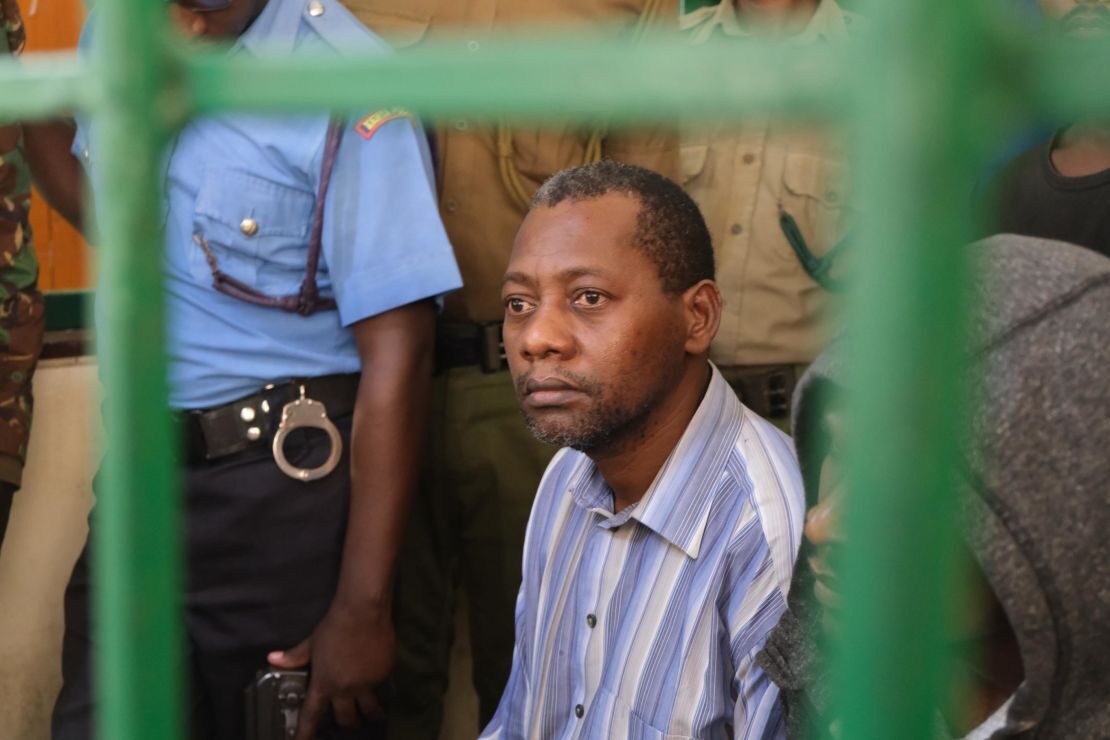
Controversial preacher Paul Mackenzie allegedly ate in secret while in police custody, even as his devoted followers continued a hunger strike believing that fasting would deliver them from criminal prosecution, a police witness has told the court.
Testifying before Principal Magistrate Leah Juma at the Shanzu Law Courts, Assistant Superintendent of Police (ASP) Noor Abdi, who formerly headed the Malindi Police Station, said Mackenzie and several of his co-accused were detained between June 6 and June 14, 2023.
According to Abdi, at least 15 suspects refused to eat for eight consecutive days, claiming that their fasting was a spiritual act aimed at seeking “divine intervention” in their ongoing case.
“We separated Mackenzie from the rest of the suspects, and our informer reported that Mackenzie ate while in the cell but did it secretly so that his followers would not notice,” Abdi told the court.
The officer said the detainees became severely weak during their hunger strike and even declined medical assistance when taken to hospital, maintaining their fast was spiritually motivated.
Abdi also presented communication reports submitted to senior police commanders detailing the mass refusal of food by Mackenzie’s followers while in custody.
The Office of the Director of Public Prosecutions (ODPP) confirmed that Abdi’s account forms part of the evidence in the ongoing prosecution of Mackenzie and 92 co-accused persons, who face multiple charges under the Prevention of Terrorism Act and the Prevention of Organised Crime Act.
Another witness, Alex Tsofia, an excavator operator, testified that Mackenzie had contracted him to dig a dam at Shakahola in Kilifi County, where the alleged cult operated. Tsofia said he worked at the site for two weeks.
Supporting his testimony, Engineer Fredrick Ako from the National Water Harvesting and Storage Authority submitted a technical report indicating that the dam was designed as a water harvesting pan with a storage capacity of 18,851.6 cubic metres, capable of serving approximately 1,090 people for an entire year. The report found no signs of irrigation or livestock use, confirming that the excavation was solely for water collection purposes.
However, depending on rainfall and usage, the report estimated that the structure could serve up to 16,498 people for three months.
The court also heard a deeply emotional testimony from Stephen Mwiti, a man whose family was allegedly destroyed by Mackenzie’s teachings.
“I sometimes walked around with the TV remote in my pocket to stop her from watching Mackenzie’s preaching, but it didn’t help,” Mwiti recalled.
He said his wife later fled their home while pregnant with their sixth child, taking their five other children with her to the Shakahola settlement.
“When I heard people were being rescued from Shakahola, I prayed to find my family alive. But I was devastated to learn that my wife and all six children, including a one-month-old baby, had disappeared,” he told the court tearfully.
A DNA test later confirmed that one of the rescued children was his. Asked by Mackenzie’s lawyer whether he would reconcile with his wife, Mwiti said he had left the matter to the court and only wanted justice served.
The ODPP noted that the case continues to reveal harrowing details about the alleged Shakahola cult, where hundreds of followers are believed to have died from starvation and indoctrination under Mackenzie’s influence.

