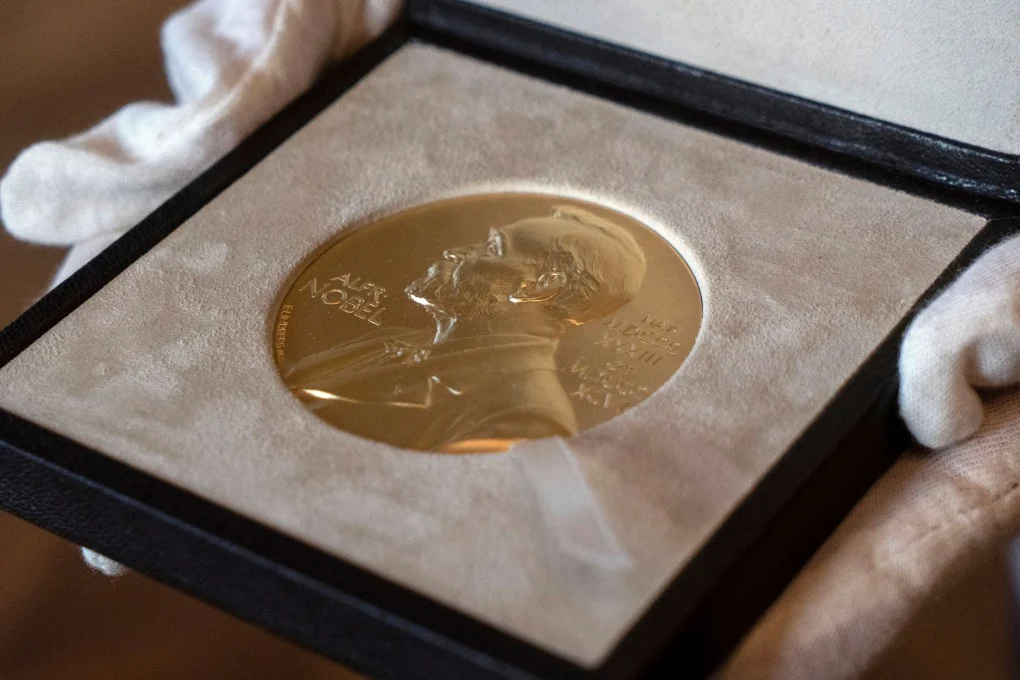
The 2025 Nobel Prize in Physics has been awarded to John Clarke (UK), Michel Devoret (France), and John Martinis (USA) for their pioneering discoveries in macroscopic quantum mechanical tunnelling and energy quantisation in electric circuits, the Nobel Committee announced on Tuesday in Stockholm, Sweden.
The laureates were recognised for demonstrating that the strange principles of quantum mechanics—usually observable only at the atomic level—can also manifest in larger, tangible systems. The committee praised their work for showing that “the bizarre properties of the quantum world can be made concrete in a system big enough to be held in the hand.”
Clarke, speaking at a press conference, said he was “completely stunned” by the recognition, noting that their 1980s research at the University of California, Berkeley, was never intended to be Nobel-winning.
Quantum mechanics explains how matter and energy behave on the smallest scales, where particles can “tunnel” through barriers. Traditionally, such effects were believed to vanish at larger scales. However, the trio’s experiments in the 1980s proved that quantum tunnelling can also occur in macroscopic systems — a discovery that reshaped understanding of the physical world.
Their superconducting electrical system, developed in 1984–85, was capable of switching between physical states in a way that defied classical expectations, illustrating quantum behaviour at a visible scale.
Physicist Anthony Leggett, a 2003 Nobel laureate, compared their findings to Erwin Schrödinger’s famous thought experiment, which highlights the paradox of objects existing in multiple states at once. Leggett noted that the trio’s work demonstrated that such phenomena are not limited to atomic particles — they can occur in larger systems too.
The Nobel Committee noted that the team’s research has laid the foundation for many modern technologies, including mobile phones, digital cameras, and fibre optics, all of which rely on quantum mechanics.
The 2025 Nobel Prize in Physics includes a cash award of approximately KSh 131 million ($1 million).
Last year’s Physics Prize went to Geoffrey Hinton and John Hopfield for their groundbreaking contributions to artificial intelligence and machine learning, while the 2023 award honoured scientists who used lasers to capture the rapid movement of electrons.