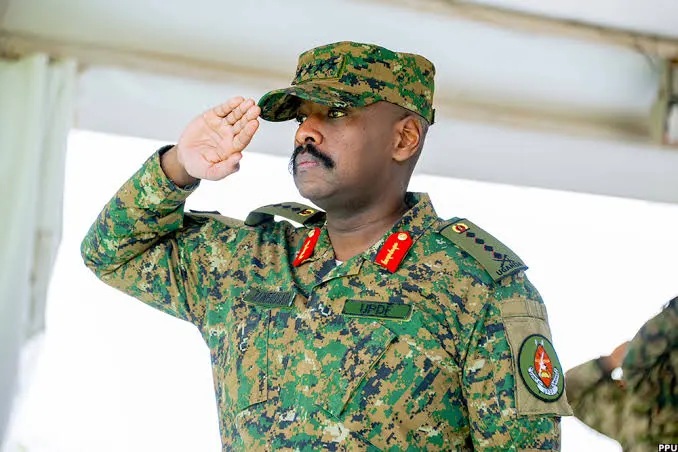
Uganda’s Chief of Defence Forces and First Son, General Muhoozi Kainerugaba, has sparked fresh political debate after publicly declaring himself a prophet following President Yoweri Museveni’s re-election.
In a statement issued on Monday, January 19, 2026, Muhoozi claimed that the election outcome validated his earlier prediction of a landslide victory for his father. He asserted that Museveni’s decisive win confirmed what he described as a prophetic declaration.
“I, Muhoozi Kainerugaba, am a prophet of Almighty God. I told you all that Mzee would win by the biggest percentage since 1996, and it happened,” he said.
Muhoozi went on to issue a controversial warning directed at Uganda’s opposition, particularly the National Unity Platform (NUP) led by Robert Kyagulanyi, popularly known as Bobi Wine. In strongly worded remarks, he suggested that the opposition party’s future in Uganda was under threat, describing its eventual removal as inevitable.
The remarks come days after President Museveni was officially declared the winner of the presidential election held on Thursday, January 15, 2026. According to the Electoral Commission, Museveni secured 72 percent of the vote, while his closest challenger, Bobi Wine, garnered 25 percent.
Bobi Wine has rejected the results, branding them “fake” and alleging widespread irregularities. He has urged Ugandans to express their grievances through non-violent protests, as tensions continue to simmer in the aftermath of the vote.
President Museveni, now 81, first came to power in 1986 after leading a rebel movement and has since won seven presidential elections. His latest victory extends his rule to more than four decades. However, the election period was marked by violence, with Bobi Wine claiming that at least 21 people were killed during the process. Authorities have so far confirmed seven fatalities.
The election was also overshadowed by a nationwide internet shutdown that began on Tuesday, January 13, 2026, limiting access to information and independent verification of events. The government defended the move as necessary to prevent misinformation, electoral fraud, and the incitement of violence. The decision was sharply criticised by the United Nations human rights office, which described it as “deeply worrying.”
Internet access has since been restored following the official announcement of the election results, but political tensions remain high as Uganda navigates the aftermath of another contentious poll.