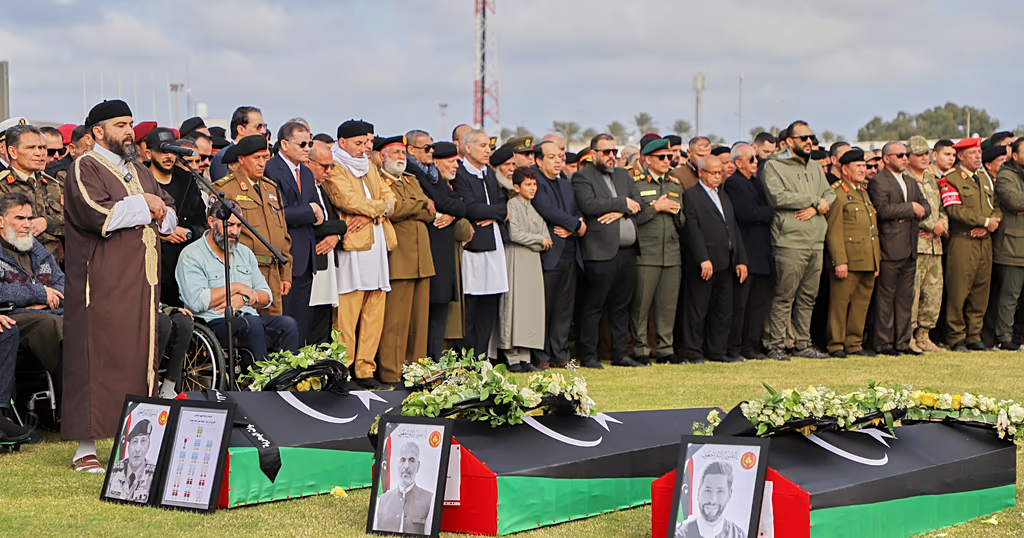
Libyan authorities have confirmed that the United Kingdom will conduct the analysis of the flight data recorder recovered from the aircraft crash in Turkey last month that claimed the lives of senior members of the Libyan military leadership, including Army Chief General Mohammed al-Haddad.
Speaking at a press conference in Tripoli, Libya’s Minister of Transport, Mohamed al-Chahoubi, stated that the United Kingdom was jointly approved by both Libya and Turkey to lead the black box analysis, in accordance with international aviation regulations. He noted that the decision followed consultations aimed at ensuring neutrality and technical credibility in the investigation process.
According to al-Chahoubi, Germany had initially been considered for the task but requested the inclusion of France in the analysis. Libyan authorities rejected that proposal, citing concerns over compliance with the Chicago Convention on International Civil Aviation, which governs aircraft accident investigations.
“Under the Chicago Convention, the country responsible for analyzing the black box must be neutral,” al-Chahoubi explained. “France is the manufacturing state of the aircraft, and the flight crew was also French. For these reasons, France is not entitled to participate in the analysis. The United Kingdom, however, was accepted by both Libya and Turkey.”
The fatal incident occurred on December 23, when a Falcon 50 aircraft carrying General al-Haddad and his delegation crashed shortly after takeoff from Ankara. The crash resulted in the deaths of General al-Haddad and four of his aides. Three crew members were also killed, including two French nationals. Turkish officials have indicated that an electrical failure may have contributed to the accident.
The flight data recorder was subsequently recovered near the crash site and secured for forensic examination. Libyan officials confirmed that the United Kingdom has formally agreed to provide both technical and legal support for the investigation. Authorities stated that the findings of the black box analysis will be made public once the examination is completed, as part of Libya’s commitment to transparency and adherence to international aviation standards.